
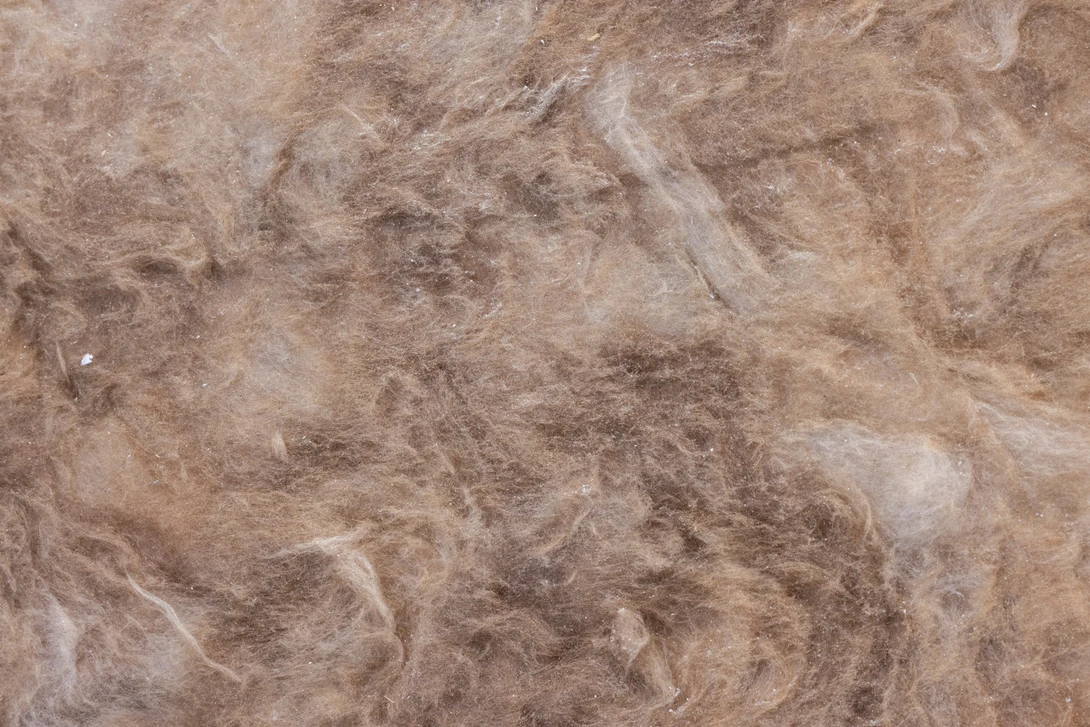
Hold a woven bag and a non-woven bag up to a work light and you'll see the whole difference in about two seconds. The woven one looks like a tarp, a tight grid of flat plastic strips with light showing at the crossings. The non-woven one looks more like felt, a mat of fibers with no pattern at all.
Both are polypropylene, and both will hold insulation. What separates woven and non-woven insulation vacuum bags on the job is how each fabric treats the fine dust riding in the airstream. A woven bag lets more of it through and is built for bulk; a non-woven bag catches more of it and is the one to reach for whenever dust is the problem. Pick by the material you're pulling and how much dust the site can tolerate.
How the two fabrics are made
Woven polypropylene is made the way cloth is made: flat tapes of plastic interlaced over and under each other. The grid gives it strength along both directions and makes a long bag practical, because the fabric doesn't stretch out of shape under load. The gaps at each crossing are what limit it. Coarse fibers stay in, but fine dust can work its way through.
Non-woven polypropylene skips the loom. Fibers are laid down in a random web and bonded into a sheet. With no regular gaps, it works as a filter: air passes through a maze of fibers and the fine particles get caught on the way. Heavier non-woven fabric means a thicker maze, which is why fabric weight, measured in ounces, is a useful clue to how much a bag filters. Our PRO-350 uses 2.4 oz fabric, while the PRO-450 steps up to 3.5 oz.
Woven bags earn their place on big, coarse loads
Fiberglass and rock wool are made of relatively coarse fibers, and on a big tear-out the priority is volume per bag and fewer changes. That's what our woven bags are designed for.
The RAM Flex-Bag with EZ Fill collar is 14 feet long and holds 115 cubic feet, against 75 for a standard bag, with a 400 pound rating. Its 18 by 12 inch spout accepts hoses as large as 12 inches, and the handles are there for shifting the bag into position. They aren't rated to lift it once it's loaded, so a dolly or a second person still does the carrying. The 13 ft Flex-Bag Multiuse has the same capacity and rating and works for machine removal or for stuffing batts by hand, which makes it handy on mixed jobs where you pull batts first and vacuum the loose fill after.
Two honest caveats. Neither Flex-Bag is a low-dust bag, and our product pages also note some airflow restriction, so woven doesn't mean the air passes through unimpeded. We ask first-time buyers of either Flex-Bag to call us before ordering so we can check it suits the machine and material.
Non-woven bags are the dust-control option
Cellulose is the material that changes the decision. It's ground up paper, and its dust is far finer than fiberglass, so a woven bag will let a visible haze escape all the way through the fill. The same goes for any attic where what floats out of the bag matters more than usual: a house with the owners still living in it, a job next to a neighbor's open windows, or an attic contaminated by rodents, mold or smoke.
Here is how our non-woven range lines up for dust:
|
Bag |
Fabric |
Capacity |
Weight rating |
Dust performance
|
|---|---|---|---|---|
|
PRO-350 Heavy Duty |
2.4 oz non-woven |
75 cu ft |
350 lb |
High filtration |
|
PRO-ECO+ |
Non-woven |
88 cu ft |
375 lb |
Low dust |
|
PRO-400 Extra Heavy Duty |
Non-woven |
75 cu ft |
400 lb |
Low dust |
|
PRO-450 Super Duty |
3.5 oz non-woven |
75 cu ft |
450 lb |
Our highest filtration, least dust |
|
PRO-RED side fill |
Super heavy duty non-woven |
88 cu ft |
450 lb |
Highest filtration, lowest dust, side spout |
Cellulose crews usually end up with the PRO-400 Extra Heavy Duty or, for the dustiest attics, the PRO-450 Super Duty. The PRO-350 is a good everyday bag for dry fiberglass and cellulose, and the step up is about both dust and weight: the PRO-450 is our toughest bag and the one we'd use on wet or heavy loads.
The trade-off with any filter fabric is that the dust it catches stays on the inside wall. On a long cellulose fill, the bag breathes a little less with every minute, so keep an eye on it and swap it out once it has gone drum-tight.
Matching fabric to the job
|
Job |
Fabric we'd choose |
Why
|
|---|---|---|
|
Large dry fiberglass attic, nobody home |
Woven |
Most volume per bag, fewer changes |
|
Rock wool tear-out |
Woven, or PRO-400/450 if dust matters |
Coarse fiber; watch the weight |
|
Batts pulled by hand |
Woven 13 ft Multiuse |
Long bag takes batts easily |
|
Loose cellulose |
Non-woven PRO-400 or PRO-450 |
Fine dust needs a filter fabric |
|
Occupied home or close neighbors |
Non-woven, low dust |
Less dust escaping on the driveway |
|
Rodent, mold or smoke contaminated attic |
Non-woven PRO-450 |
Highest filtration in our range |
|
Wet or water damaged insulation |
Non-woven PRO-450 |
450 lb rating for heavy loads |
One thing fabric can't fix is asbestos. Low dust is not the same as HEPA, and no insulation vacuum bag, ours or anyone's, carries a HEPA rating. Treat vermiculite as if it contains asbestos, test anything else that looks suspect, and let a licensed abatement contractor handle it.
A bag's fabric also does nothing for the crew's own exposure up in the attic. Respiratory protection and coveralls are a separate decision from which bag sits on the driveway.
Get the right fabric on the truck
Plenty of crews keep a case of each fabric on the truck so a surprise cellulose attic doesn't stall the day, and you can see both side by side in our full range of insulation vacuum bags. If you're unsure which suits your material, call us at 404-354-6268; the phone is answered 24/7, and orders go out the same day with free shipping.
Frequently Asked Questions
Is woven or non-woven fabric stronger?
Both are strong when they're used within their ratings, and it's the weight rating that tells you what a bag can carry. Our woven Flex-Bags are rated for 400 pounds, and our non-woven bags run from 350 to 450 pounds. For the heaviest, wettest loads, the non-woven PRO-450 has the highest rating of our standard bags.
Can I use a woven bag for cellulose?
We don't recommend it. Cellulose dust is fine enough to pass through woven fabric, so you'll get a cloud around the bag for the whole fill, and the neighbors will notice before you do. Any of our low-dust non-woven bags is the better choice.
Why does a non-woven bag sometimes feel tighter as it fills?
As a filter fabric catches dust, fewer pores stay open for the air to escape, so pressure inside the bag rises. That's normal, and it's the reason to change bags as soon as one looks overinflated rather than pushing for a few more minutes.
Does a low-dust bag mean I can skip respiratory protection?
No. The bag controls what escapes outside on the driveway, not what's in the air around the crew up in the attic. Follow respirator guidance for the material and conditions in the attic regardless of which bag you use.
Do woven and non-woven bags fit the same hoses?
Our non-woven bags and the 13 ft Flex-Bag fit hoses up to 10 inches. The EZ Fill collar version has a larger 18 by 12 inch spout and takes hoses up to 12 inches.