
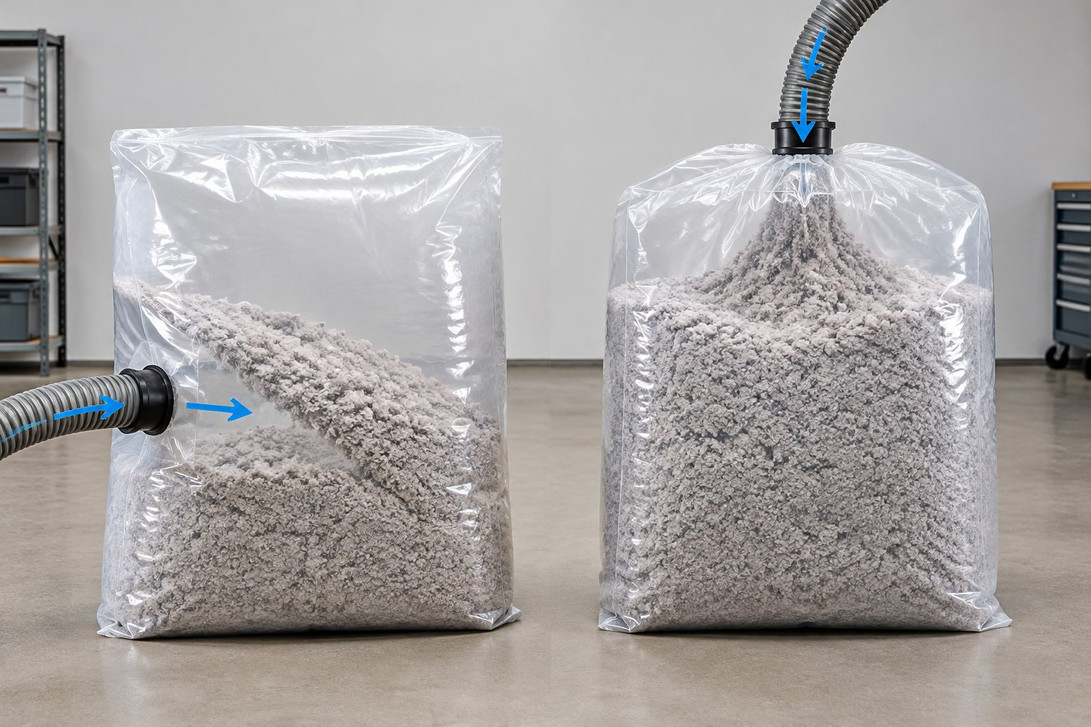
Most crews never think about where the spout is on their bags until the day the bag has to sit somewhere awkward: wedged into a truck bed, lined up along a narrow side yard, or laid out on a tarp with the hose coming in at an angle. That's usually when someone asks us about a side fill insulation vacuum bag.
The straight answer is that a side spout doesn't make a bag hold more or fill faster on its own. What it changes is the geometry. With the spout on the long side, the bag can lie flat and take the hose broadside, which suits some setups much better than a spout at the end. If your hose route and staging area already work with a standard bag, there's no reason to switch. If you keep fighting kinks, twisted spouts or a bag that won't sit still, the spout position is worth a look.
What changes when the spout moves to the side
On a conventional top fill bag (some crews call it end fill), the spout sits at one end. Laid on the ground, the bag stretches away from the hose, and the end nearest the spout is where the material arrives first.
The RAM PRO-RED side fill bag moves that spout to the long side of a 7 by 4 foot bag. The hose meets the bag broadside, and the incoming air has the whole length of the bag on either side of the spout to spread into. In practice that helps in a few ways:
- The hose can approach parallel to a wall, a truck bed rail or a fence line rather than having to come straight at the end of the bag.
- The bag can be laid along the long edge of a tarp or bed without needing extra clearance at one end for the hose.
- There's a natural place to stand while you watch the fill, since the spout faces you rather than pointing away down a narrow space.
None of this matters on a wide-open driveway. It matters a lot in tight spots.
Setups where a side spout makes life easier
Truck beds. When the bed is long enough to take a 7 foot bag lengthwise, an end spout means the hose has to come in over the tailgate or the cab end and turn to meet it. With a side spout, it can come over the bed rail and drop straight in, with less of the sideways pull that tugs at the spout opening.
Narrow side yards and driveways. When the only staging space is a strip between a house and a fence, a bag lying lengthwise along the strip with the hose entering from the side keeps the whole setup in a line, without the hose looping around the end.
Tarp staging. On a tarp, the bag can sit along one edge with the hose arriving from the open side, leaving the rest of the tarp clear for the next empty bag.
Moving the spout doesn't change the one setup rule we never bend: the bag still gets fed from a length of hose, never fastened straight to the machine's exhaust.
When a standard end spout is the better fit
If the vacuum sits at one end of a long, open staging area, an end spout lines up naturally: machine, hose, bag, in a straight line. Many crews have run that way for years and have no reason to change.
Standard bags also give you more choice. Our 75 cubic foot range comes in three weight ratings, from the PRO-350 for dry fiberglass and cellulose up to the PRO-450 Super Duty for rock wool and wet loads, which lets you buy for the attic in front of you. The PRO-RED comes in one heavy-duty build.
PRO-RED and PRO-ECO+: same footprint, different spout
The closest comparison in our range is the PRO-ECO+, which shares the PRO-RED's 7 by 4 foot size and 88 cubic foot capacity. If you're deciding between a side fill and a standard spout at that size, these are the two to compare.
|
PRO-RED side fill |
PRO-ECO+
|
|
|---|---|---|
|
Spout |
Side |
Standard |
|
Size and capacity |
7 x 4 ft, 88 cu ft |
Same |
|
Weight rating |
450 lb |
375 lb |
|
Fabric |
Super heavy duty non-woven |
Non-woven |
|
Dust |
Highest filtration in our range |
Low dust |
|
Hose fit |
Up to 10 in |
Up to 10 in |
So the PRO-RED is more than a relocated spout. It's also built to the same top filtration and weight rating as our toughest bags, which makes it a good choice for cellulose, heavier loads and dusty jobs where the side spout helps the setup. The PRO-ECO+ is the lighter option for dry fiberglass or cellulose when a standard spout works fine.
Getting a clean fill from a side spout
The fill habits are the same as any bag: seat the hose fully in the spout and secure it, keep the hose supported so its weight doesn't drag the opening out of shape, and stop at about 85 percent so there's slack to close the bag. With a side spout, a couple of extra points help:
- Lay the bag flat with the spout facing up and slightly toward the hose, so the hose enters without a sharp bend at the bag.
- Keep the spout clear of folds in the fabric. A crease across the opening restricts the airflow right where it matters.
- Watch both ends. Material should build along the length of the bag; if one end is filling much faster, straighten the bag or adjust the hose angle.
Try a side fill bag on your next tight setup
If the spout position on your current bags keeps causing kinks or awkward staging, put a case of PRO-RED bags on your next order and see how it changes the setup. It sits alongside the rest of our insulation removal bags if you want to mix it into a standing order, and shipping is free and same-day. For help with an odd staging situation, describe it to us on 404-354-6268; somebody answers around the clock.
Frequently Asked Questions
Does a side fill bag hold more insulation than a standard bag?
No, capacity comes from the bag size, not the spout position. The PRO-RED holds 88 cubic feet and up to 450 pounds, the same volume as our PRO-ECO+ and more than our 75 cubic foot bags.
Will a side fill bag work with my existing hose?
If your hose is 10 inches or smaller, yes. The PRO-RED fits all insulation vacuums with hoses up to 10 inches, the same as our standard bags, and has the same 12 by 10 inch easy-fill spout.
Is the PRO-RED a good bag for cellulose?
Yes. It uses super heavy duty non-woven fabric with the highest filtration in our range, which is what you want for fine cellulose dust. Its 450 pound rating also gives you headroom if the cellulose is damp or packed.
Can I mix side fill and standard bags on the same job?
Absolutely. Some crews keep a few side fill bags for the truck bed or a narrow staging spot and use standard bags everywhere else. The fill limits and handling are the same, so nothing about the process changes between them.