
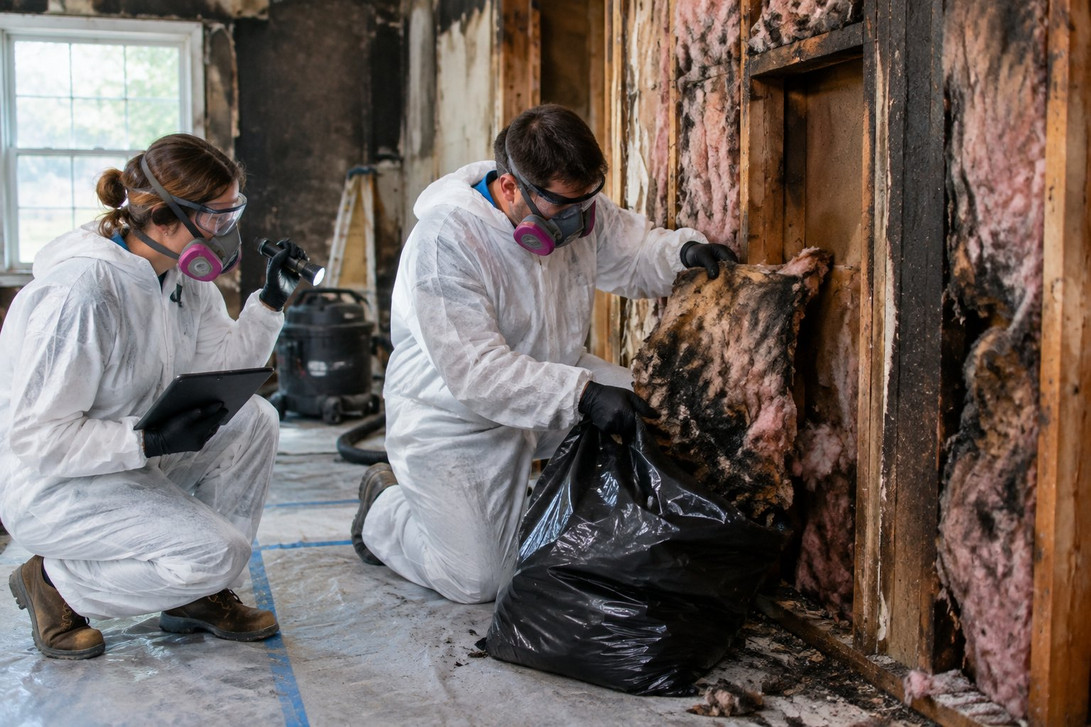
Walk into an attic a week after a kitchen fire and the insulation over the burn room is obviously gone: black, crusted, half melted into the facing. Ten feet away it looks fine. Bury your face in it and it smells like a campfire. That second patch is where most of the arguments about fire damaged insulation happen, with the homeowner, the adjuster and sometimes your own crew.
Our view, and the view of most restoration crews we supply, is that if insulation is charred, melted, sooted or holds smoke odor, it comes out. Insulation is built to trap air, which also makes it superb at trapping smoke particles and the compounds that cause odor. No fogger or ozone run is going to pull them back out of a few inches of fluff.
Clear the space before you assess it
Nobody assesses a fire attic until fire officials have released the building and the utilities have been made safe. After that, two hazards stay with you for the whole job:
- Weak framing and ceilings. Heat can char joists and rafters and weaken connections, and suppression water softens ceiling drywall. Step only on sound framing or walk boards, and treat anything charred as suspect until it's been looked at.
- Damaged wiring. Cables in the attic may have lost insulation to heat. Keep power to the area off until an electrician has checked it.
In older homes, also check what kind of insulation you're looking at before you disturb it. Vermiculite is pebbly rather than fluffy, and the EPA describes vermiculite insulation as usually gray-brown or silver-gold and advises leaving it undisturbed. Insulation removal bags aren't HEPA filters (ours aren't, and neither is anyone else's), so vermiculite or any material that might contain asbestos stays put until it's been sampled, and if it's positive the job belongs to licensed abatement, not a removal vacuum.
Read the damage by what you can see and smell
A fire leaves four different kinds of damage in an attic, often overlapping. Mapping them separately makes your scope easier to defend.
Char and heat damage
Directly over the fire, insulation may be blackened, crusted or fused. Fiberglass fibers themselves don't burn readily, but the binder that holds batts together, the kraft or foil facing and any plastic vapor retarder can scorch or melt, and the batt loses its shape. Cellulose chars. Foam board melts, shrinks or chars. Whatever the material, if it has lost thickness or fused into a mat it no longer insulates and has to go. Check the framing underneath for charring at the same time.
Soot film
Further out, you'll find insulation that looks gray or dusty on top rather than burned. That's soot, and it doesn't stay on the surface. Fine particles settle down into loose fill and between batt fibers. Soot from burning plastics and furnishings can be greasy and acidic, and it smears rather than brushing off. Sooted insulation is a removal item.
Smoke odor without visible residue
This is the patch that looks clean but smells. Smoke travels through the attic along the path of least resistance: up through ceiling penetrations, along eaves and around framing. It can leave odor well outside the visibly damaged area. Odor alone is a sound reason to remove insulation, because the source of the smell is now inside the material. Document it carefully, though; adjusters want to see why you're removing insulation that looks fine in photos.
Suppression water
Fire hoses put a lot of water into a building, and it runs downhill. Insulation in attics and ceilings below or beside the fire floor can be soaked even where there was no smoke at all. Wet, sooty insulation is the worst combination: heavy, dirty and slow to dry. Treat it as both a fire and a water loss.
Build the removal boundary from the damage map
Sketch the attic or the floor plan and mark each zone: char, soot, odor only, water. Note where you couldn't get access. Then set the removal boundary at the edge of the outermost zone you're removing, plus a margin, rather than at the edge of the scorch mark.
Photograph each zone wide (so the location is clear) and close (so the condition is clear) before anything is touched, then again as cavities are opened. Keep a count of bags removed. That record is what gets the scope paid and what protects you if odor shows up after the rebuild.
Odor treatment comes after removal, not instead of it
It's tempting to fog the attic and see if the smell goes away. It might, for a while. Deodorizing equipment treats air and surfaces, but insulation has an enormous amount of internal surface area, and the residue inside it keeps releasing odor as temperatures swing. Warm summer afternoons in an attic are exactly when a "treated" smell comes back.
The sequence that holds up is: remove the contaminated insulation, clean soot from the framing and sheathing, dry anything wet, seal the cleaned wood if the restoration plan calls for it, then treat any lingering odor in the now-empty structure.
Remove it without spreading soot through the house
Soot is fine, light and gets everywhere. The goal is for none of it to leave the attic except inside a closed bag.
- Isolate the attic. Seal the hatch, recessed light openings and other ceiling penetrations from below where you can, and protect the path from the hatch to the exit.
- Put the machine and bags outside. The vacuum sits outdoors and the bags stage outside, so exhaust and dust never enter the house. Keep several feet of hose between the vacuum outlet and the bag so nails and charred chunks lose their speed in the hose instead of punching into the fabric.
- Pull damaged batts by hand, then vacuum loose fill. Charred batts are brittle; fold them into bags rather than dragging them across the attic.
- Clear the most distant bays first. Working back toward the hatch means nobody crawls over cleared, sooty framing.
- Fill to about 85 percent and close the bag at the fill point. Sooty material is dusty, and a little headroom lets you tie it off without a puff of black dust.
Suits matter on fire jobs. Soot ruins clothing and tracks easily, so crews tend to wear a microporous coverall such as our Microvek Heavy Duty suits, which have an anti-static coating and a storm flap over the zipper, and strip it at the hatch.
For the bags themselves, fine soot is the reason to go with high-filtration fabric. Our PRO-450 Super Duty bag has the highest filtration and least dust of our range and a 450 pound rating for loads that are also wet. On the machine side, the RAMVAC-23 is built to handle heavy damp material from water, fire and smoke damage.
Before new insulation goes in
The cavity should be clean of soot, dry by moisture meter, free of smoke odor and structurally sound, with any electrical repairs complete. Photograph the empty, cleaned attic before insulation goes back. That one set of pictures answers most of the questions that come up later.
Plan the bag count for fire conditions
Fire-damaged insulation takes more bags than a dry estimate suggests, especially when suppression water is involved, so add 10 to 15 percent. Our free bag calculator has a fire damaged condition setting, and you can see every option on the RAM insulation vacuum bags page. There is no charge for shipping and the bags leave the same day, so if a fire loss has you second-guessing the scope, call 404-354-6268. Someone here picks up 24/7.
Frequently Asked Questions
Can smoke damaged insulation be cleaned and left in place?
Not reliably. Cleaning methods that work on hard surfaces can't reach residue spread through a porous, fibrous material, and odor tends to return in warm weather. Remove it, clean the structure and treat odor afterward.
Does insulation need to be replaced if the fire was in another room?
Possibly. Smoke moves through attics and wall cavities well beyond the burn room, and suppression water can soak insulation on other floors. Inspect and smell the insulation throughout the affected area rather than assuming damage stops at the burn room's walls.
Is fiberglass insulation fireproof?
The glass fibers are noncombustible, but the products aren't fireproof as a whole. Binders, paper or foil facings and vapor retarders can burn or melt, and heat can ruin a batt's shape even when the fibers survive.
What should a fire insulation claim include?
A damage map showing char, soot, odor and water zones, wide and close photos of each, moisture readings where water was involved, bag counts and photos of the cleaned cavity before reinsulation. Clear documentation is what supports removing insulation that looks undamaged.
How long should we wait after a fire before removing insulation?
Start as soon as the building is released and the structure and utilities are safe. Wet insulation left in place invites mold, and soot residue can etch and stain surfaces it sits on, so delay makes the job bigger.