
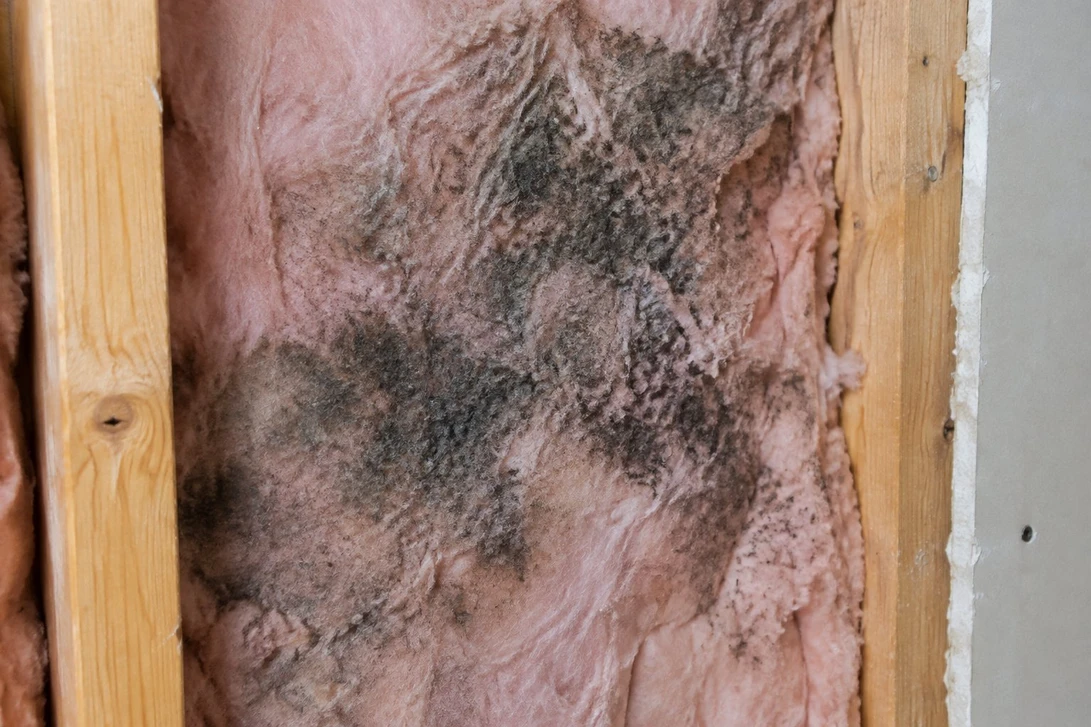
Half the "black mold on insulation" calls we hear about aren't mold at all. They're dark streaks on fiberglass where air has been leaking up through the ceiling for twenty years, and the insulation has done its job as a filter, catching household dust and soot. The other half are real growth, and the giveaway is almost always water.
So start with the question that matters: is the dark stuff on dry insulation in a pattern that follows air leaks, or on insulation that has been wet? Dry streaks are usually dirt. Dark, fuzzy or blotchy patches on insulation that's been wet are mold until proven otherwise, and visibly moldy insulation comes out.
Dust staining and mold look alike from the hatch
From a few feet away with a flashlight, both are just dark patches on insulation. Up close they're different.
|
What you see |
Filtration staining (dirt) |
Mold growth
|
|---|---|---|
|
Location |
Over ceiling penetrations, top plates, around light fixtures and the hatch |
Under roof leaks, near bath fan ducts, along cold sheathing, low spots that collected water |
|
Pattern |
Lines and fans that follow gaps; darkest at the leak point |
Spots and blotches that spread outward; often patchy |
|
Texture |
Flat, embedded in the fibers |
Fuzzy, powdery or slimy surface on top of the fibers or facing |
|
Moisture history |
Insulation and wood are dry |
Water stains, damp or matted insulation, rusty nails |
|
Smell |
Dusty |
Musty, earthy |
Filtration staining is a useful finding in its own right. It shows you exactly where the air leaks are, and those leaks should be sealed before new insulation goes in. But it isn't a mold problem.
Color doesn't tell you what kind of mold it is
"Black mold" has become shorthand for dangerous mold, but color isn't a reliable way to identify a species. Many molds are dark, and the same mold can look different depending on what it's growing on. For deciding what to do with insulation, the species doesn't change the answer: visibly moldy porous insulation gets removed whatever color the growth is. Testing has its place, for example when occupants have health concerns or a clearance report is needed, but it isn't needed to justify pulling moldy insulation.
Where mold actually grows on insulation
Glass fibers aren't food for mold. What mold grows on is everything else that ends up in and on the insulation:
- Kraft paper facing on fiberglass batts. Damp paper is one of the easiest places for mold to take hold, which is why faced batts in a damp crawl space or under a leak often show growth on the paper first.
- Dust and debris trapped among the fibers. Decades of attic dust are organic enough to feed growth once moisture shows up.
- Cellulose itself. It's made of paper, so wet cellulose supplies moisture and food in the same place.
- The wood next to it. Often the heaviest growth is on the sheathing or joists, and the insulation is contaminated by contact and by spores settling into it.
Rock wool and foam don't feed mold either, but dust and the surfaces around them can.
Why moldy insulation is removed, not cleaned
Insulation is porous all the way through. Spores and growth sit in the spaces between fibers and inside the facing where no brush, spray or wipe can reach, and disturbing the material to clean it releases more of them into the air. OSHA's mold remediation guidance lists insulation alongside carpet and drywall as porous materials to discard when they're visibly moldy and can't be properly cleaned, and calls for removed material to be sealed in plastic bags.
Spraying a mold treatment onto insulation and leaving it in place doesn't remove anything; the growth and spores stay put, and so does the musty smell. Removal also gives you the only proper look at what's behind the insulation: the sheathing, the framing and the leak that started it all.
The one common exception is rigid foam board. Its surface isn't fibrous, and FEMA's flood mold guidance treats rigid insulation as the type that can be reinstalled after disinfecting and drying, while other wet insulation is discarded. That still depends on the board being undamaged and the growth being confined to its surface.
Find the water before you pull the insulation
Mold needs water, so the growth on the insulation is really a pointer to a moisture problem: a roof or plumbing leak, a bath fan that vents into the attic, or warm, humid air condensing on a cold surface. Replace the insulation without finding and fixing that, and the new material will grow the same mold. On attic jobs the cause is often bigger than the moldy patch, and sorting it out (along with cleaning the sheathing) is a project of its own.
Getting moldy insulation out without spreading it
How much containment and PPE you need depends on how big the area is and who is doing it. Small, isolated patches are a different job from a whole attic. For anything beyond a small patch, this is work for a mold remediation crew. Whoever does it, the material handling is the same:
- Contain the work area. Close off the hatch and ceiling openings from the living space so spores don't drift down into the house.
- Suit up properly. A fitted respirator, eye protection, gloves and a disposable coverall that you remove at the exit. Our Microvek Heavy Duty coveralls put a microporous, latex-free barrier between the crew and the spores, and at 50 to a pack there's no excuse for reusing one.
- Bag faced batts by hand. Roll them in on the moldy side and put them straight into a bag. Don't shake them or drag them across the attic.
- Vacuum loose fill to bags outside. Park the machine and bags outdoors so nothing exhausts into the house, feeding the bag through a stretch of hose rather than clamping it to the machine. Clear the bays farthest from the hatch first so nobody crawls back through finished areas.
- Close bags at the fill point. Fill to about 85 percent so there's room to tie off without squeezing dust out of the spout.
Dusty moldy material is a filtration problem as much as a volume one. For moldy loads we steer crews to the PRO-450 Super Duty bag, which lets the least dust through of any bag we make, and the PRO-400 Extra Heavy Duty bag is a low-dust option rated for 400 pounds. Neither is HEPA rated (no insulation vacuum bag is), so neither should go anywhere near vermiculite or other material that might contain asbestos. If you find that, stop, get it tested and leave any asbestos to a licensed abatement contractor.
Order bags before you open the attic
Moldy insulation that's also damp fills bags by weight faster than you'd expect, so build in 10 to 15 percent extra. Enter the attic dimensions, insulation depth, material and condition into the free RAM bag calculator and it works out how many of each bag model the job needs. Everything in our full bag range ships at no cost the day it is ordered, and if a mold job has you unsure which bag to use, 404-354-6268 reaches us 24/7.
Frequently Asked Questions
Can mold grow on fiberglass insulation?
Not on the glass fibers themselves, but readily on the paper facing, on dust trapped among the fibers and on nearby wood once moisture is present. That's why fiberglass in a damp spot can still be visibly moldy.
Is it safe to sleep in a house with moldy attic insulation?
It isn't something to live with long term. Keep the hatch closed and sealed, don't disturb the insulation, and get removal scheduled promptly. If anyone in the house has asthma, allergies or other health concerns, ask their doctor for advice in the meantime.
Can I just remove the moldy section and leave the rest?
Sometimes, if the growth is limited to a small area around a leak and the surrounding insulation is dry and clean. Remove a margin of clean material around the visible growth, and if mold shows up in several places, plan on replacing the whole attic.
Will a dehumidifier kill mold in insulation?
No. Lowering humidity stops new growth from getting started, but it doesn't remove existing mold or the spores already in the insulation. Remove the moldy material first, then control humidity so it doesn't come back.
Does homeowners insurance pay to replace moldy insulation?
It depends on the policy and the cause. Mold resulting from a sudden covered event such as a burst pipe is more likely to be covered than mold from long-term leaks or condensation. Photograph everything before removal and check with the insurer early.