
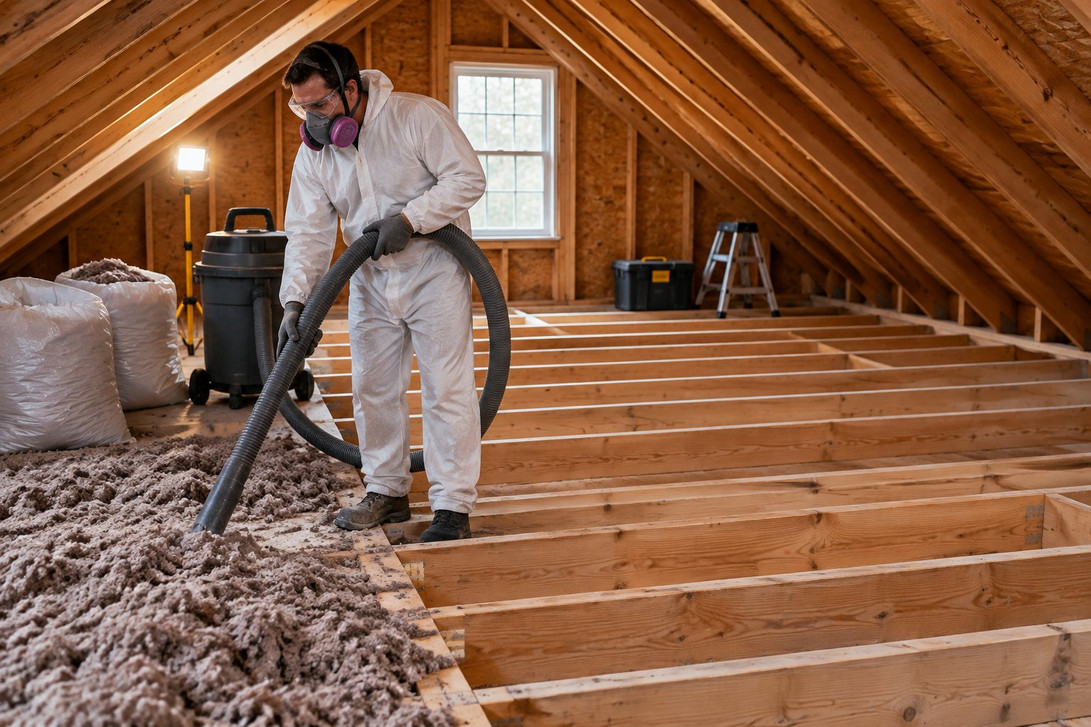
The attic is the one room on a flip that the buyer's inspector will definitely see and you might not, unless you go up there on purpose. Plenty of investors who call us learned that the hard way: new floors, new kitchen, fresh paint, and then an inspection report that mentions droppings, a stained roof deck and insulation sitting four inches deep where it should be twelve.
Our advice on attic insulation removal for house flippers is simple. Make the call in the first week of the project, and if the old insulation is coming out, pull it before the electrician and HVAC crew climb up. An empty attic shows you problems while they are still cheap to fix, gives every trade room to work, and gives the buyer's inspector a clean attic to photograph instead of a question mark. For house flippers, that last part is worth more than the rest.
Read the attic before you close, not after demo
Ten minutes at the hatch with a strong flashlight, ideally during your inspection period, tells you most of what you need for the budget. Look at the depth and type of material, the condition of the roof deck, and anything that doesn't belong. This is how we'd translate what you see into line items:
|
What you see from the hatch |
What it usually does to the budget and schedule
|
|---|---|
|
Clean, dry, even insulation that's just thin |
Often a top-up candidate, unless you're air sealing or doing major work above the ceiling |
|
Droppings, tunnels, nests or a urine smell |
It comes out. Exclusion first, then removal, then cleaning the attic floor |
|
Water stains, clumped or matted patches |
Find and fix the leak, remove the wet sections, check the decking |
|
Smoke smell or soot |
It comes out. The odor stays as long as the insulation does |
|
Old wiring buried under the insulation |
Your electrician will need it clear, so plan on removal |
|
Gray-brown or gold pebbles that look like gravel |
Stop. That may be vermiculite, and it needs testing before anyone touches it |
That last row matters more than the rest put together. The EPA says that if a home has vermiculite insulation, you should assume it may be contaminated with asbestos and leave it undisturbed. Since no removal bag is HEPA rated (RAM's included), there's no safe DIY version of that cleanout. Get it tested and, if it's positive, price licensed abatement into your offer. Better to learn that before closing than in week three.
Removal belongs near the front of the rehab schedule
Removal itself is rarely what holds a flip up. Waiting on trades who can't work in a packed attic is. A sequence that keeps things moving:
- Test anything suspect and get the results back.
- Seal entry points if animals have been in, and repair roof leaks.
- Remove the old insulation.
- Clean the exposed attic floor if there was rodent or wildlife activity.
- Let the electrician, HVAC and plumbing crews do their attic work.
- Air seal the top plates and penetrations while everything is exposed.
- Reinsulate, then patch and finish the ceilings below.
Two practical reasons to keep removal early. First, vacuuming is dusty and involves people kneeling on joists above the ceiling, so you want it done before new paint, flooring and ceiling patches go in. Second, an empty attic is the only time you can see the whole roof deck and every wire run. Anything ugly you find becomes part of the scope now, rather than a renegotiation after the buyer's inspection.
Your own crew or a sub: the deciding factors
Flippers who do a few houses a year often end up doing clean removals in house. It's straightforward work with the right setup, and it keeps the schedule in your hands. We'd keep it in house when:
- The material is dry fiberglass or cellulose with no heavy contamination.
- The hatch, roof pitch and walking room are reasonable.
- You have two people who can work a few hours in a hot attic in coveralls and respirators.
- You can stage filled bags and get them hauled off without fuss.
We'd sub it out when the attic is heavily fouled by rodents or wildlife, when there's mold on the framing, when access is miserable, or when your crew is already the bottleneck on three other tasks. A specialist crew with its own truck can often turn a nasty attic around faster than you can rent equipment and talk your guys into it. And anything that might contain asbestos goes to a licensed abatement contractor, full stop.
If you're doing removals on most of your projects, owning a machine starts to make sense. Our RAMVAC-23 insulation vacuum is a 23 HP gas machine that copes with the soggy, smoke-damaged attics flippers tend to inherit, and it can blow into bags or straight into a truck or dumpster. Call 404-354-6268 for a quote.
For the crew themselves, breathable coveralls make a long day in a summer attic more bearable, and microporous suits are the better pick when there are droppings involved. Both come in packs of 50 on our disposable coveralls page. Respirators, gloves and eye protection come from your safety supplier.
Plan bags and haul-off around the demo dumpster
Most flips already have a roll-off in the driveway for demo debris, and that changes the math on insulation. Instead of filling and carrying a stack of 75 cubic foot bags, you can line the dumpster with a large-format bag and vacuum straight into it. Our trailer and dumpster bags fit standard dumpsters from 15 to 40 yards, and the insulation stays contained instead of blowing across the street every time the wind picks up. Check with your hauler that bagged insulation can ride along with the demo load.
If you're bagging by hand, size the order before demo week so you aren't stuck waiting on a delivery. Plug the attic's footprint, depth, material and condition into our free insulation bag calculator and it tells you how many of each bag you need. Order 10 to 15 percent more than it suggests, and more again if the insulation is wet or packed down.
Document the attic so buyers can see the work
Buyers can't see the work you did above the ceiling unless you show them. Take wide photos from the hatch before removal, close-ups of anything you fixed, and another set once the new insulation is in. Keep the exclusion invoice, the roof repair receipt and any test results in the same folder. When the inspector writes "attic appears recently insulated", your listing agent can answer every follow-up question in one email.
Be accurate in the listing. "New attic insulation and air sealing" is a fair selling point. Promising a specific drop in utility bills is not, unless you have numbers for that house.
Stock the bags before demo week
A flip schedule doesn't have room for a missing supply run. Our insulation vacuum bags fit every insulation vacuum with hoses up to 10 inches, and we ship them free on the day you order. Ring 404-354-6268, day or night, and we'll help you match bags to the attic in front of you.
Frequently Asked Questions
Can I just blow new insulation over the old stuff before listing?
Only if the existing layer is clean, dry and free of droppings or odor. Covering contaminated insulation hides it from you but not from a thorough inspector, who may pull back a corner. It also leaves the smell and any moisture problem in place under your new material.
How many removal bags does a typical flip attic take?
Take a 1,200 square foot attic with a foot of fiberglass. Filled to the brim, each 75 cubic foot bag would cover about 75 square feet, but at our recommended 85 percent fill you'll use around 19, or 21 to 22 once you add the 10 to 15 percent spare. Use the calculator for wet or compacted material, which takes more.
Do I need accredited workers if a test comes back positive for asbestos?
The EPA notes that federal law doesn't require accreditation for asbestos work in detached single-family homes, but some states and localities do. Either way, it recommends hiring trained and accredited professionals, and so do we. It also advises using separate firms for testing and for removal to avoid a conflict of interest.
Can the drywall crew work downstairs while we vacuum the attic?
We'd keep them apart. Removal shakes loose dust around light fixtures, the hatch and any gaps in the ceiling, and people moving on the joists can crack fresh tape and mud below. Run the attic first, clean up, then bring in the finish trades.
Should I remove insulation if I'm replacing the roof anyway?
Sometimes. A roof replacement doesn't require it, but if the old insulation is soaked from the leak that prompted the new roof, it has to come out regardless. Schedule removal after the roof is dry, so you're not reinsulating under a deck that's still letting water in.