
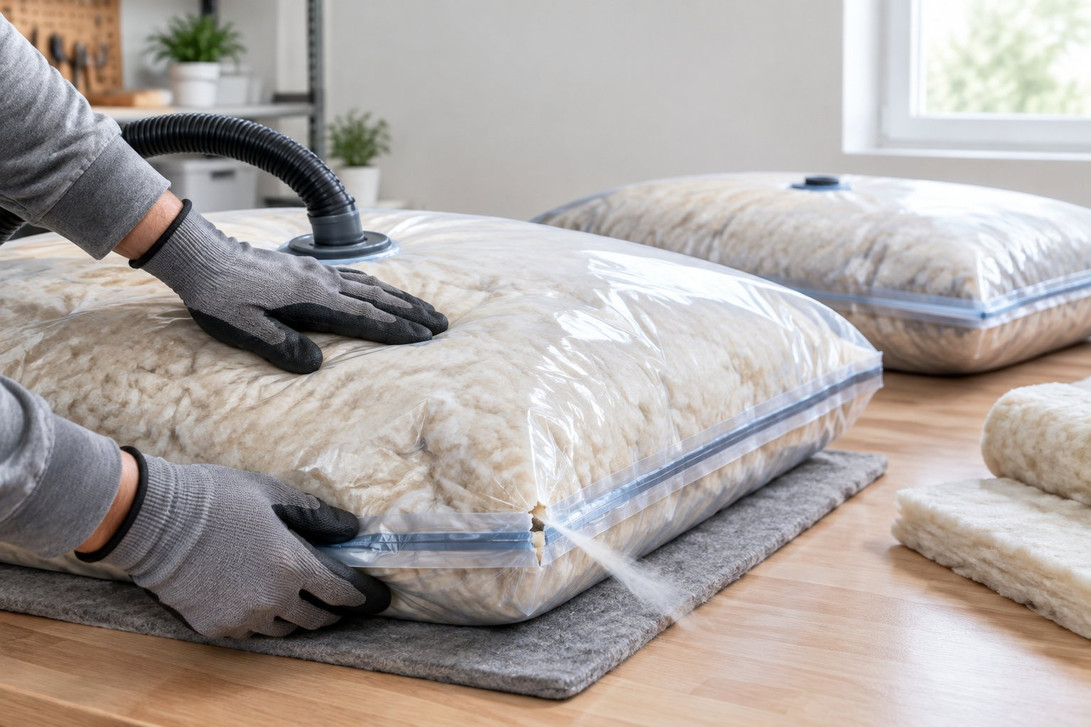
You're forty minutes into an attic, the machine is pulling well, and then the bag in the driveway lets go with a pop and a cloud of gray dust drifts across the client's lawn. Anyone who has run an insulation vacuum for a few seasons has a story like that.
When people ask us why insulation vacuum bags tear, the honest answer is that it's rarely bad luck. Bags fail at three predictable moments: at the inlet, when debris slams into the fabric; during the fill, when pressure or weight goes past what the bag can take; and on the way to the truck, when a loaded bag gets dragged or dropped. Sort out the habits at each of those points and blowouts become rare.
Inlet failures start with what the machine throws
A removal vacuum doesn't just move fluff. It pulls up roofing nails, staples, wire ties, wood splinters and the occasional mouse skeleton, then fires all of it out of the exhaust at speed. If the bag is clamped straight onto the machine outlet, that debris hits the same patch of fabric over and over until something gives.
That's why our setup guidance always carries the same safety note: run a section of hose between the vacuum and the bag. The hose knocks debris down before it reaches the bag wall and lets the airflow settle before it enters. On higher-horsepower machines, this one change prevents more tears than any other.
A few related habits help at the spout:
- Seat the hose fully in the fill spout and secure it, so it can't whip around or tug at the opening as the bag inflates.
- Make sure the hose suits the bag. Our standard bags take hoses up to 10 inches in diameter.
- Pull loose boards and obvious lumber out of the attic before vacuuming rather than letting the hose swallow them.
Mid-fill blowouts come down to pressure and weight
A clogged bag turns into a balloon
An insulation vacuum bag is a filter. Air has to escape through the fabric while the insulation stays inside. As fine dust builds up on the inside wall, fewer pores stay open, back-pressure rises and the bag swells tighter and tighter. Cellulose is the worst offender because its dust is so fine. Keep pushing and the weakest seam or the spout takes the strain.
Watch for a bag that looks drum-tight early in the fill, or suction that fades at the attic end even though the hose is clear. Both mean the bag is struggling to breathe, and the fix is to change it rather than force another few minutes into it.
Fabric choice matters here too. Our PRO-450 Super Duty bag uses our heaviest 3.5 oz non-woven polypropylene and has the highest filtration in the range, which is why we steer dusty cellulose jobs toward it. Woven bags such as the Flex-Bag are built for fiberglass and rock wool, but they aren't low-dust bags, so they're the wrong pick for fine cellulose.
Filling past 85 percent leaves no slack
A bag filled to the brim has no room for the insulation to settle and no spare fabric to gather when you close it. We recommend stopping at about 85 percent of capacity, which on a 75 cubic foot bag works out at roughly 63 usable cubic feet. That margin is also what lets you tie the bag off without squeezing a puff of dust out of the spout.
Wet and dense loads hit the weight limit before the bag looks full
Every bag has two limits, volume and weight, and it's the weight limit that catches people out. Damp cellulose, fiberglass soaked by a roof leak and rock wool all weigh far more per cubic foot than dry blown fiberglass, so a bag can reach its weight rating while it still looks half empty. For rock wool, fill to no more than about 75 percent. For anything wet, use your strongest bag and fill it lighter than usual.
Here's how the main RAM bags are rated:
|
Bag |
Capacity |
Weight rating |
Best suited to
|
|---|---|---|---|
|
PRO-350 Heavy Duty |
75 cu ft |
350 lb |
Dry fiberglass and cellulose |
|
PRO-400 Extra Heavy Duty |
75 cu ft |
400 lb |
Fiberglass, rock wool and cellulose |
|
PRO-450 Super Duty |
75 cu ft |
450 lb |
Rock wool, wet and heavy loads |
|
PRO-RED side fill |
88 cu ft |
450 lb |
Fiberglass and cellulose with a side spout setup |
|
Flex-Bag with EZ Fill collar |
115 cu ft |
400 lb |
Fiberglass and rock wool (not low dust) |
The trip to the truck is where good bags get ruined
A full bag is heavy and its fabric is already under tension, so it punctures and scuffs far more easily than an empty one. Most handling tears happen in the last fifty feet of the job.
- Don't drag full bags across shingles, concrete, gravel or a deck with raised nail heads. Lift them, use a dolly, or carry them between two people.
- Don't drop bags through the attic hatch or off a tailgate. A falling bag can split on impact or catch a nail on the way down.
- Stage filled bags on a tarp in a clear spot, well away from the demo pile.
- Don't leave full bags sitting in strong sun for days. Polypropylene breaks down under UV over time, so plan the haul-off promptly.
If getting full bags down a ladder is the real problem, there are two good workarounds. In tight attics, our PRO-200 small bags hold about 250 pounds each and fit through a 22 inch opening, so you can fill them in the attic and carry them out at a manageable size. On bigger jobs, skip the carrying altogether: trailer and dumpster bags line the trailer bed or roll-off, so the vacuum fills one large bag in place and nothing has to be hauled by hand.
Matching the bag to the job is the cheapest fix
Most of the tears we hear about come from a bag that suited one job being used on a very different one. A lighter bag on a dry fiberglass attic is fine. The same bag on a soggy cellulose tear-out after a roof leak is asking for trouble. Before you start, think about the material, whether it's wet or contaminated, how far the bags have to travel and what horsepower you're running, then pick from there.
The free bag calculator gives you a count for each RAM bag once you enter the attic size, insulation depth, material type and condition. If you'd rather talk it through, call us at 404-354-6268. We answer 24/7, and orders ship free the same day within the US. You can see the whole lineup on our insulation vacuum bags page.
Frequently Asked Questions
Can I patch a torn insulation vacuum bag and keep using it?
We don't recommend it. Tape won't hold against the pressure of a running vacuum, and a bag that has already split has a weak point that will open again under load. Close up what's inside if you can do it safely, double-bag it for disposal and switch to a fresh bag.
Why is my bag blowing dust when it hasn't torn?
A little dust passing through the fabric is normal with any filter bag, but heavy dusting usually means the fabric doesn't suit the material. Woven fabric is meant for fiberglass and rock wool, where the fibers are coarse enough to stay put. For fine cellulose dust, a low-dust non-woven bag such as the PRO-400 or PRO-450 is the better choice.
Are insulation vacuum bags safe to use for asbestos?
No. No insulation vacuum bag on the market is HEPA rated, ours included, and none should be used for asbestos or for vermiculite that may contain asbestos. Treat any vermiculite as asbestos-containing, have other suspect material tested, and bring in a licensed abatement contractor.
Do bigger bags tear more easily than small ones?
Not because of their size. A larger bag simply holds more weight when it's full, so handling becomes the main risk. That's why large-format bags are designed to be filled in place inside a trailer or dumpster rather than carried.
Which RAM bag should I use for a wet job?
Go for the PRO-450 Super Duty. It carries the highest weight rating of our 75 cubic foot bags at 450 pounds. Fill each one lighter than you normally would, and change bags as soon as they start to look tight.