
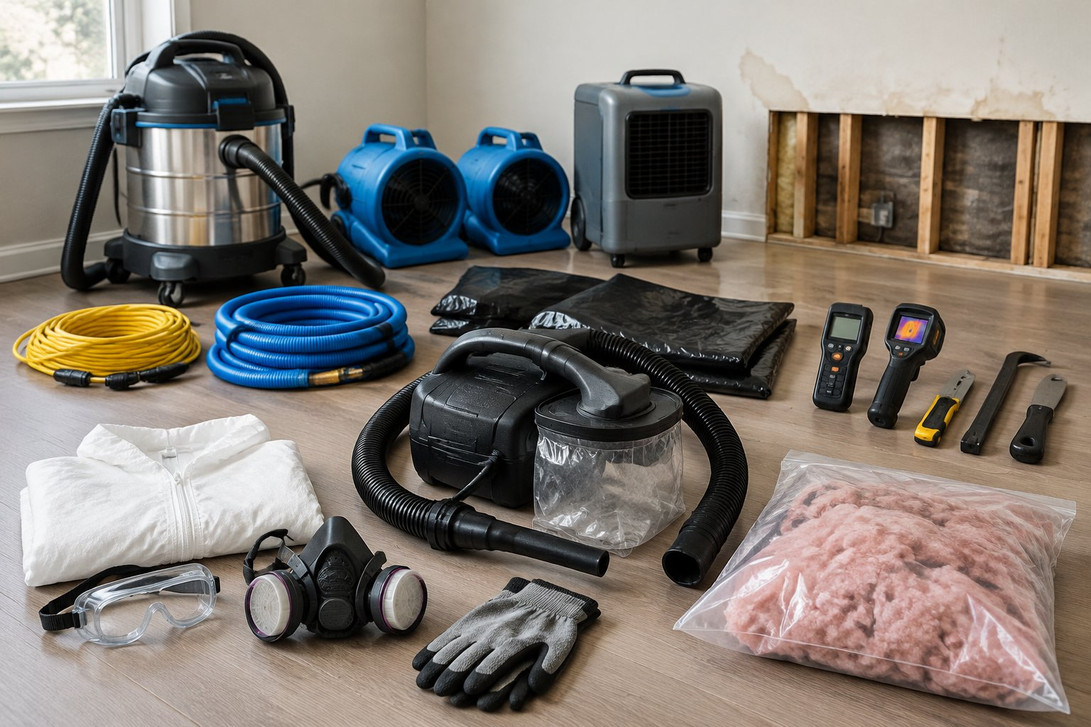
The call comes in at 2 a.m.: a second-floor supply line let go, water ran across the bathroom floor, through the ceiling below and into the attic insulation over the garage on its way down. By the time you arrive, the van needs to hold everything for the first visit, because nobody wants to drive back to the shop at 4 a.m. for a forgotten meter.
This water damage restoration equipment checklist is organized the way a mitigation job runs: make it safe, find the water, get it out, dry what's left, control contamination, open things up, document everything, and deal with the wet insulation most kits forget. It's sorted by category rather than brand, because the right model is whatever your crew knows and can keep running.
Safety and power: before anything gets plugged in
Water and electricity share the same rooms on every job, so this category comes first.
- Non-contact voltage tester
- GFCI-protected cords and adapters, plus spare cords
- Circuit map or panel labels, and a way to check available amperage before running multiple machines
- Battery work lights and headlamps (the lights in a wet area should be off)
- Wet floor signs, caution tape and floor protection for the route in and out
- First aid kit and eyewash
The CDC's disaster safety guidance says that when wiring or equipment is wet or near water, power should be shut off at the main breaker or fuse, and that you should never switch power or use electric tools while standing in water. If the panel is wet or you have to wade to reach it, that's an electrician's job.
Inspection and moisture mapping: find all of the water
Water travels further than it looks. These tools tell you where it went and, later, when it's gone.
- Pin moisture meter, with insulated pins long enough for wall plates and subfloor
- Pinless (non-penetrating) meter for fast surveys of drywall and flooring
- Thermo-hygrometer for temperature, relative humidity and dew point
- Thermal imaging camera for screening (confirm anything it shows with a meter)
- Flags, tape or stickers to mark wet boundaries
- Inspection mirror and flashlight for cavities and under cabinets
Extraction: get the bulk water out first
Every gallon you extract is a gallon your dehumidifiers don't have to pull out of the air. Extraction is the cheapest drying you'll do.
- Portable extractor with recovery tank (for upper floors and tight access)
- Truck-mounted extraction, if your operation runs one
- Carpet wands and weighted or stand-on extraction tools for carpet and pad
- Squeegees and wet vacuums for hard floors
- Submersible pump and discharge hose for standing water in basements and crawl spaces
- Hoses, clamps and spare fittings
Structural drying: air movement and dehumidification
- Air movers (axial and centrifugal styles both earn their keep)
- Low-grain refrigerant dehumidifiers sized for the drying chamber
- Desiccant dehumidifier for cold conditions, large chambers or dense materials
- Wall cavity and under-cabinet drying attachments
- Hardwood floor drying panels or mats, if you take on flooring
- Condensate hoses and pumps routed to a drain
- Poly sheeting to build drying chambers
Set air movers to sweep air across wet surfaces and run dehumidification alongside them; moving air without removing moisture just raises the humidity in the room.
Contamination control and PPE
Clean water can turn into gray or black water, and Category 3 losses bring sewage and floodwater into play. Stock for the worst job you'll accept, not the easiest.
- Air scrubbers with HEPA filtration, plus spare pre-filters and HEPA filters
- Poly sheeting, tape, zipper doors and spring-loaded poles for containment
- Antimicrobial or disinfectant products (used per label, on surfaces that have been cleaned)
- Sprayers for applying them
- Respirators appropriate to the hazard, inside a respiratory protection program
- Nitrile and heavy-duty gloves, eye protection and rubber boots
- Disposable coveralls
For coveralls, crews tend to keep two types on the truck: breathable suits for hot attics and general dirty work, and microporous suits for contaminated material. We carry both in our disposable coveralls range, in packs of 50.
Controlled demolition and debris handling
- Utility knives, drywall saws and an oscillating multi-tool for flood cuts
- Pry bars, hammers and baseboard removal tools
- Reciprocating saw and drill/driver
- Heavy-duty debris bags and contractor bags
- Wheelbarrow or debris cart, and floor protection for the debris route
- Chalk line and level for consistent flood cut heights
Documentation
- Camera or phone with a job documentation app
- Moisture map sketches with numbered reading points
- Daily drying logs (readings, equipment count and placement)
- Signed work authorization and scope notes
Your logs are what get the job paid. Take readings at the same points every visit so the drying curve is easy to follow.
The insulation removal kit most water trucks are missing
Here's where many water jobs stall. A ceiling leak soaks the attic insulation above it, and the crew has extractors, air movers and dehumidifiers but no way to get wet loose fill out of an attic. You can't dry a ceiling or the framing above it with soaked insulation sitting on top, and the same CDC guidance is clear that insulation contaminated with sewage or floodwater should be removed and discarded.
This is the part of the checklist we supply:
- Insulation removal vacuum. A wet vac can't move attic insulation. A dedicated removal vacuum parked outside does. Our RAMVAC removal vacuums have abrasion-resistant steel fans and chambers, so soggy cellulose and wet fiberglass don't chew up the machine; call us for a quote.
- Removal hose, sized to the machine, with an extra length so the bag hangs off the end of a hose run instead of sitting right on the machine's outlet.
- Bags rated for wet weight. Wet insulation reaches a bag's weight rating long before it fills the volume. Our PRO-450 Super Duty bag is rated for 450 pounds at 75 cubic feet, which is as strong as our bags get. Fill wet loads well below the usual 85 percent.
- Trailer or dumpster bags for big losses. On whole-attic or multi-unit jobs, trailer and dumpster bags are sized for a dump trailer bed or roll-off container and can swallow a whole attic in one or two fills, so nobody hauls dripping bags down a ladder.
- Walk boards and a stable work platform, because wet loose fill hides joists and wet drywall won't hold a misstep.
- Coveralls you can strip at the hatch, so wet fibers don't track through the house.
One caution belongs on every truck's checklist: removal bags (ours and everyone else's) aren't HEPA rated. A wet attic with vermiculite or any other possible asbestos in it is a testing and licensed abatement job, not a vacuum job.
Stock the removal side before the next attic leak
Soaked insulation chews through bags faster than a dry-attic estimate predicts, so keep 10 to 15 percent more on the truck than the number you'd guess. Set the condition to wet in our free insulation bag calculator for a count of each RAM bag. Bags leave us free of charge the same day you buy them, and restoration crews putting a removal kit together can phone 404-354-6268 at any hour for help choosing what to stock.
Frequently Asked Questions
What equipment do you need to start a water damage restoration business?
At minimum: moisture meters and a thermo-hygrometer, a portable extractor, a submersible pump, air movers, dehumidifiers, an air scrubber, containment supplies, PPE and documentation tools. Many startups rent large or specialty equipment until job volume justifies buying it.
How many air movers and dehumidifiers does a water job need?
It depends on the size of the affected area, the class of water damage and the materials involved. Industry drying standards give placement and sizing guidance, and your readings should drive adjustments: if the numbers stall, change the setup rather than just adding machines.
Can a wet/dry vacuum remove wet insulation from an attic?
Not on any meaningful scale. Portable wet/dry vacuums clog almost immediately on wet cellulose and loose fill and hold very little. Attic insulation needs a dedicated removal vacuum feeding large bags outside the house.
Should restoration companies buy or rent insulation removal equipment?
If you pull wet insulation every month or two, owning a removal vacuum means you're never waiting on rental availability during an emergency. If wet attics are rare, renting the machine and keeping bags in stock can make more sense; the bags are the part you need on the truck every time.
Do I need a separate checklist for mold jobs?
Yes. Mold remediation leans much harder on containment, negative air, HEPA filtration and HEPA vacuuming, while water mitigation is built around extraction and drying. There's overlap, but the priorities are different.