
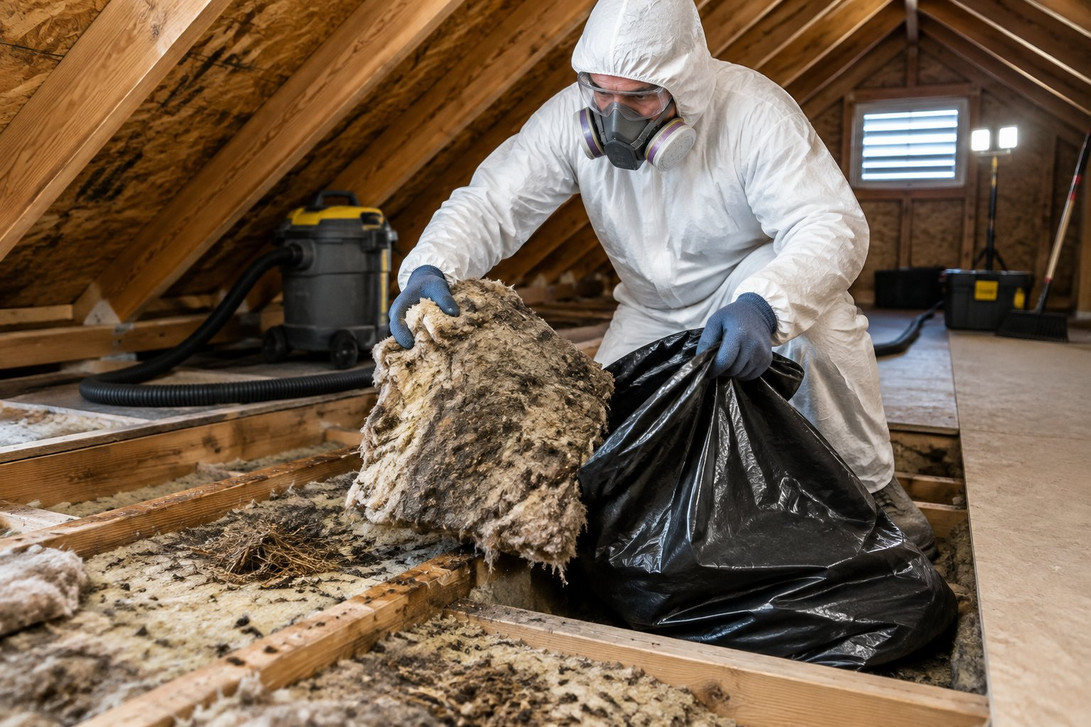
Your tech pops the hatch on a pest control insulation install and the old cellulose is gray, flattened and peppered with mouse droppings from one end of the attic to the other. The blowing machine is on the truck and the customer is expecting a two-hour job. This is the moment that decides whether the upgrade actually works.
In most attics like that one, the old insulation has to come out before the borate-treated pest control insulation goes in. Blowing a fresh layer over soiled, compressed material buries the contamination, hides the gaps pests use to get in, and makes it impossible to air seal or measure what you've installed. Removal turns a cover-up into a proper job, and for a pest control company it's also a service worth selling on its own line.
Blowing over a dirty attic buries the problems you were hired to fix
Contamination stays put. Droppings, urine and nesting material don't go anywhere when you cover them. They sit under the new layer, and so does the smell.
Entry points disappear. Rodents and insects get into attics through gaps at the top plates, around pipes and wires, and along the eaves. Those gaps are much easier to find and close with the attic floor bare than after another eight inches of insulation has been blown over them.
Air sealing gets skipped. ENERGY STAR tells homeowners to do the attic air sealing before adding insulation. With old insulation in the way, nobody seals anything, and the customer's energy savings suffer for it.
Depth readings mean nothing. Old insulation that has been tunneled through, flattened and pushed into piles makes it hard to say how much new material went where. If the job ever gets questioned, you want depth markers sitting on a clean, even base.
The product label still applies. Borate-treated pest control insulation comes with a product label that sets out which pests it's for and how it must be installed. Following it is easier on a clean, level attic floor than on a lumpy layer of soiled cellulose.
When the old insulation can stay
Removal isn't automatic. If the existing insulation is dry, evenly spread, free of droppings and nesting, and there's no sign of active pests, it can often stay, with the treated layer installed on top after the gaps are sealed. Fiberglass batts in good condition along the edges of an otherwise contaminated attic can sometimes be left in place too.
Document the decision either way. Photos of clean, dry insulation that you chose to keep protect you just as much as photos of the soiled material you removed.
Quote the removal while you're inspecting for the install
The inspection for a pest control insulation job and the inspection for removal are the same trip, so capture both:
- Insulation type and depth in several places
- Where the droppings, urine staining and nesting are, and how far they spread
- Any wet or moldy areas, and the leak or condensation behind them
- Hatch size and location, plus where you can park the vacuum and run the hose
- Entry points that need exclusion work before anything is installed
- Chewed wiring or ductwork that needs another trade
Older homes need one extra check. If you see vermiculite, the light, gravel-like granules in shades of gray-brown or gold, or any other insulation that might contain asbestos, don't disturb it. Get a sample tested, and if it's positive the work belongs to a licensed abatement firm. Our bags, like all insulation removal bags, aren't HEPA rated and must never be used on asbestos.
Put your measurements into our free bag calculator, choose the condition that matches what you saw (wet, packed and so on), and add 10 to 15 percent. That gives you a bag count to build the removal line from.
Removal and install in one visit: sequencing the day
On light to moderate contamination, one crew can usually remove and reinstall in the same visit. The order is what keeps it clean:
- Protect the house. Cover the route to the hatch and set up the removal vacuum outside, with a hose run up into the attic.
- Remove. Batts come out by hand into bags before the hose goes in. Then vacuum the loose fill, working from the most distant corner back to the access.
- Clean the floor. Pick up remaining droppings and nesting, wet with disinfectant first rather than swept dry, and treat the soiled areas.
- Seal. Close the entry points, then air seal around top plates, wires and pipes while nothing is covering them.
- Install. Bring in the blowing machine, set depth markers and blow the borate-treated insulation to the specified depth.
Keep removal and installation as separate phases. Running the removal hose and the blowing hose in the same attic at the same time makes a mess of both. Heavy contamination, wet insulation or repairs that need an electrician usually push installation to a second visit.
The removal kit a pest control branch needs
A removal vacuum. Rental machines are a reasonable start. Once removal becomes a weekly line, owning one means it's on the trailer when the job is booked. Our RAMVAC removal vacuums are built for daily removal work, and we quote them by phone.
Low-dust bags. Old cellulose is fine and dusty, and you're doing this in an occupied home. Our non-woven PRO-400 Extra Heavy Duty and PRO-450 Super Duty bags are the low-dust choices for cellulose, and the whole range is on our insulation vacuum bags page.
A trailer bag for bigger attics. Our dump trailer and 40 yard dumpster bag fits the bed of a dump trailer, so the vacuum fills one 540 cubic foot bag where it sits. Nobody carries full bags down a ladder, and the old insulation leaves in one trip.
Coveralls. For hot summer attics, our breathable Cool-Suits coveralls keep fiberglass and dust off your techs without cooking them. For heavily soiled attics, step up to our Microvek suits. Respirators, gloves and eye protection you'll source from your usual safety supplier, since we don't sell them.
Sell removal as its own line
Removal is different work from installation: a different machine, different consumables, different disposal and different hours. Show it as its own line on the quote, with the photos that justify it. Customers accept a removal charge far more readily when they've seen their own attic on your tablet.
Talk to RAM before your next install season
If your branch is adding removal ahead of pest control insulation installs, call us at 404-354-6268 to talk through bags, trailer setups and a RAMVAC quote. Someone answers 24/7, and RAM orders for bags and suits go out free the same day.
Frequently Asked Questions
Does borate-treated insulation get rid of mice and rats?
Check the product label, which lists the specific pests it's intended for. Borate-treated insulation shouldn't be sold as a substitute for rodent exclusion and trapping. Seal the entry points and deal with active rodents before the new insulation goes in.
Can my pest control techs handle insulation removal?
Yes, with training and the right equipment. Removal adds heat, dust and fall hazards that a quick inspection visit doesn't, so give techs a written procedure, the right PPE and planks or plywood to stand on rather than balancing on joists.
Which RAM bag should I use for removing old cellulose?
The PRO-400 or PRO-450. Both are non-woven and built to hold back fine dust, which is what old cellulose throws off. Save the woven Flex-Bags for fiberglass and rock wool; they aren't low-dust bags and let too much cellulose dust through.
What if the old insulation is fiberglass batts?
Batts come out by hand and go straight into bags, which is quicker than vacuuming. On mixed attics, pull the batts first, then vacuum the loose fill. Our 13 ft Flex-Bag Multiuse is designed for batt removal as well as machine removal.