
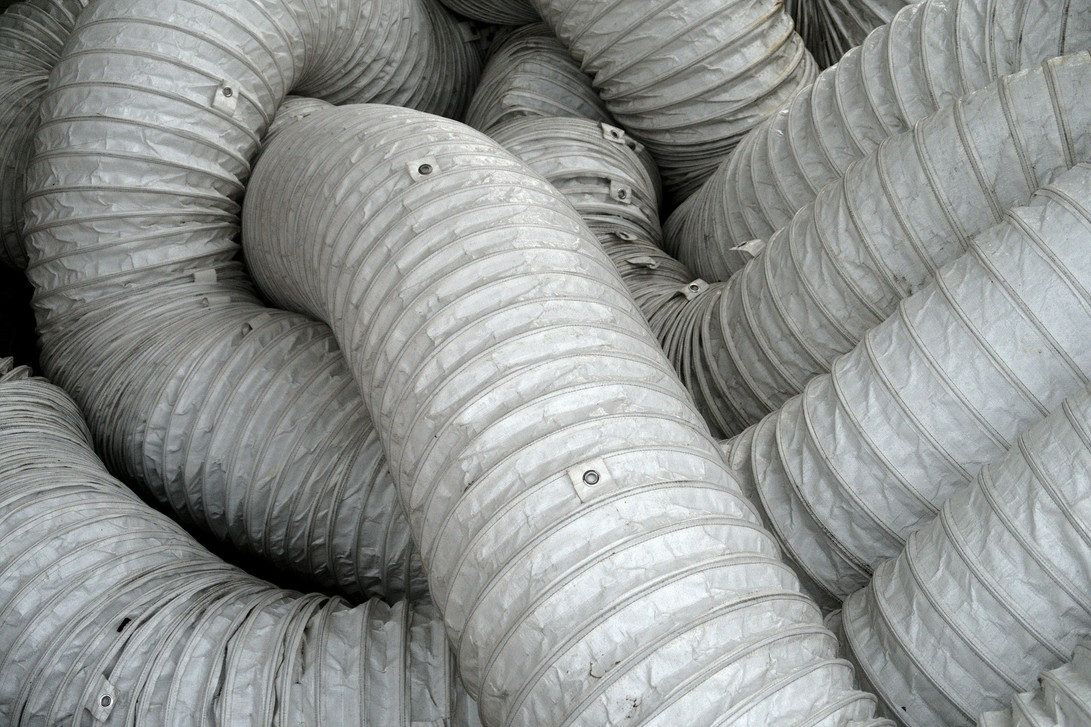
Two crews can show up with the same machine and finish the same attic hours apart. More often than not, the difference is lying on the ground between the truck and the house. An insulation vacuum hose that's too narrow, too long, kinked at the hatch or joined with a sloppy coupler can rob a strong machine of a big share of its pull, and nothing on the engine will tell you why.
The short version: run the diameter your machine was built for, use as little length as the job allows, keep bends wide, seal every joint, and never let the bag hang directly off the machine outlet. The rest of this guide explains why each of those matters and how to set it up on a real job.
Every setup has two hoses doing two different jobs
The intake side is the working hose, from the attic back to the machine inlet. Its job is to carry air and insulation with as little resistance as possible, and it's where almost all your suction is won or lost.
The exhaust side runs from the machine outlet to the bag (or the trailer or dumpster bag). The material has already gone through the fan by this point, so the exhaust hose isn't about suction at all. Its job is to calm things down before they reach the bag fabric. We'll come back to that, because it's the part people skip most often.
Diameter: match the machine, and step down only where you have to
Hose diameter sets how much air the system can move and how big a clump can pass without bridging. The RAMVAC-23 has an 8 inch inlet, and on the 40 HP diesel RAMVAC we also recommend 8 inch hose for the highest production. Whatever machine you run, start with hose that matches its inlet.
The temptation is to go smaller because an 8 inch hose is heavy and awkward to drag between joists. A reducer at the working end is a fair compromise on tight attics, as long as you follow two rules:
- Keep the narrow section short. A few feet of smaller hose at the nozzle end gives you control without turning the whole run into a bottleneck.
- Never step down and then back up. Material slows in the narrow section and drops out where the hose widens again, which is a ready-made clog point.
Every reducer should have a smooth inside taper. A sharp internal step catches fiber, and once a few strands snag, the rest of the stream piles in behind them.
Length is friction, and the attic doesn't care how far away you parked
Air dragging along the inside wall of a hose loses energy, and that loss adds up with every foot. Double the length and you've roughly doubled the friction on that run. The machine keeps spinning just as fast; it simply pulls less air at the nozzle, and slower air drops heavy material sooner.
A few habits keep length under control:
- Park the machine as close to the access point as you safely can, outdoors.
- Lay out only the sections you need. Spare hose left coiled on the driveway still counts, and a tight coil adds bends on top of the length.
- If you need more reach for the far corners, add a section for that stretch of the job and take it off again when you're working near the hatch.
On wet, packed or fire-damaged material, the effect of a long run shows up sooner, because heavier insulation needs more air speed to stay moving.
Bends and uphill climbs cost more than straight runs
A smooth, wide curve costs a little. A tight bend costs a lot, and a kink can stop flow entirely. The worst spot on most jobs is the hatch edge or a gable vent frame, where the hose folds over a hard edge at close to a right angle. Pad that edge, angle the hose so it enters at a slope, and give it enough slack that the weight of the hose doesn't pull it into a crease.
Height is the other cost, though not always where people expect it. On an attic job the material travels downhill from the gable to the machine, so the drop itself isn't the problem. What a two-story wall really adds is hose: twenty-odd feet of extra length, plus the climb from the attic floor up and over the vent sill or hatch frame. Anywhere the material has to go uphill (out of a crawl space to a machine at grade, or up and out of a sunken attic bay) costs far more than the same length laid flat. Budget for it:
- Shorten the horizontal run to compensate when a tall wall eats into your hose.
- Support the vertical hose with a rope or strap at the top so its weight hangs from the structure, not from a coupler.
- Avoid low dips where the hose sags and then climbs again. Material settles in the bottom of the dip and builds into a plug.
Running hose up the outside of the house to a gable vent is often better than threading it through hallways and a ceiling hatch, because you avoid both the tight interior bends and dragging a dusty hose through living space.
Couplers and clamps are where suction leaks out
On the intake side, a leaky joint pulls outside air into the hose instead of air from the nozzle. The machine sounds fine, but the attic end feels weak. Check couplers with the machine running: you'll usually hear a hiss or feel the draw at a bad joint.
- Seat each hose end fully on the coupler before tightening the clamp.
- Tighten clamps enough to seal without crushing the hose wall.
- Look inside each coupler for burrs or lips that could snag fiber, and file them smooth.
- Wrap any joint that keeps leaking with heavy tape as a stopgap until you can replace the coupler or the damaged hose end.
The exhaust hose is there to protect the bag
Whatever the attic hose swallows, the fan throws out the other side at full speed, and that includes the shingle nails and staples. Mount a bag directly on the outlet and those strikes land on one spot of fabric for hours.
A length of exhaust hose solves it. Debris slaps the hose wall instead of the bag, and the air has a chance to slow down before it reaches the spout. It's the one setup rule printed on every RAM bag listing, and on high-horsepower machines it isn't optional. Give that section a gentle curve and set the bag on a tarp a few feet from the machine, never hanging off it.
Then match the hose to the spout:
|
Bag |
Spout |
Fits hose up to
|
|---|---|---|
|
Standard RAM bags (PRO-200 to PRO-RED) |
12 x 10 in easy-fill spout |
10 in |
|
18 x 12 in collar |
12 in |
|
|
One inlet (12 Yard) or four inlets (PRO-20 YARD and 30 Yard) |
Four-inlet bags take hoses from two machines at once |
Push the hose well into the spout and fasten it; a loose end thrashes as the bag inflates and works the opening wider. If the exhaust hose is kinked or crushed, the bag fills slowly and pressure backs up toward the machine, so check that section as carefully as the intake. Our full range of insulation vacuum bags fits all insulation vacuums, with the hose limits shown above.
A hose that keeps clogging in the same place is telling you something
Repeated plugs at one spot usually come down to a crushed section, a worn inner wall, a rough coupler or a dip in the layout. Replace hose that has gone soft and flattens under suction, that has split near the cuffs, or that has worn through where it rubbed a gutter or hatch frame. Store hose loosely coiled, out of the sun and with nothing heavy on top, and it will last a lot longer.
Hose is only one of the things that set a day's output. We've written up the rest in our piece on hourly removal rates and what limits them.
Line up the bags before you roll out the hose
Once the hose is sorted, the next thing that stops a job is running out of bags. Tell us your hose size and the material, and we'll point you to the bags that fit. Orders leave the warehouse the day they're placed, with shipping on us, and 404-354-6268 is answered at any hour.
Frequently Asked Questions
What size hose do most insulation removal vacuums use?
Removal machines typically run large-diameter hose, with 8 inch common on gas and diesel units; both RAMVAC models are set up for it. Smaller sections are often used at the nozzle end for handling. Always check your machine's inlet and outlet sizes before buying hose or couplers.
Can I use a 10 inch exhaust hose on an 8 inch machine?
You can step up on the exhaust side with a suitable adapter, and it won't hurt suction because the material is already past the fan. The main things to check are that the adapter is secure and that the hose still fits the bag spout, which on standard RAM bags is up to 10 inches.
Does a clear hose work better than a standard one?
Clear hose lets you see where material is slowing or building up, which helps you spot a developing clog before it plugs. It doesn't move more air on its own; diameter, length, bends and smooth joints matter far more than whether you can see through it.
How long should the hose be between the vacuum and the bag?
There's no magic number. Long enough to include one easy curve and to let the bag sit a few feet from the machine without pulling on the spout. Anything longer just adds weight to drag around, and anything shorter tends to leave the bag leaning on the engine.
Why does my hose collapse when I block the nozzle?
When the nozzle is buried or sealed against the material, the vacuum inside the hose spikes and a worn or soft-walled hose can flatten. Pull the nozzle back to let air in, and replace hose sections that keep collapsing, since they'll restrict flow even when they recover.