
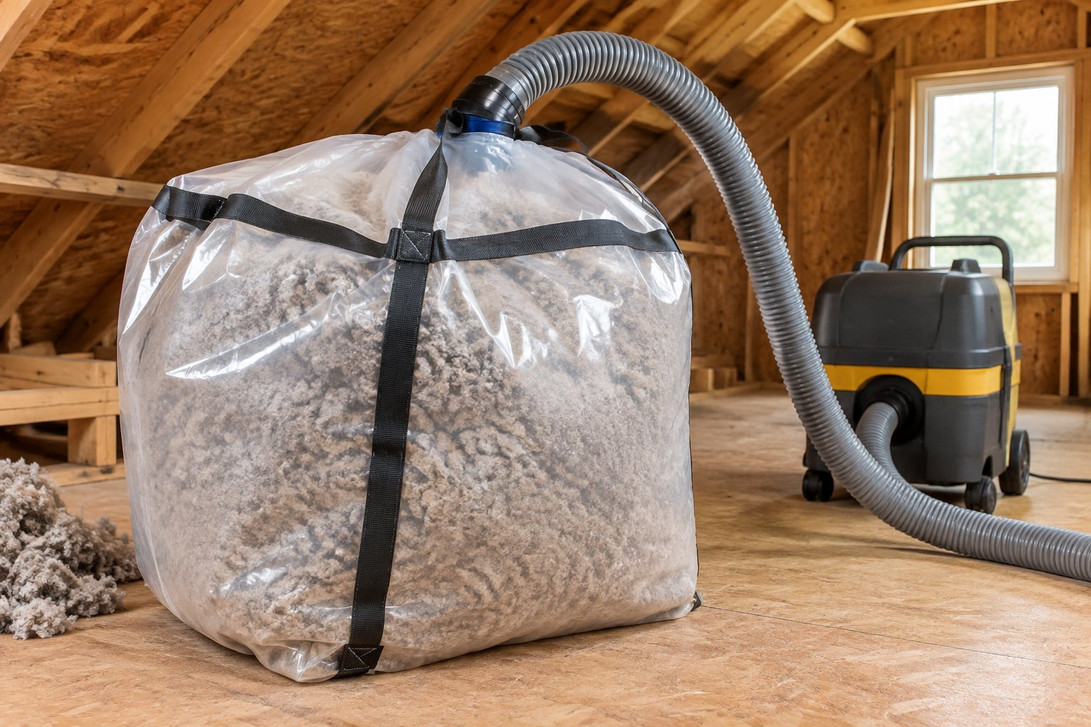
The smallest bag we sell is 22 inches wide so it can go up through a tight attic hatch. The biggest is 16 feet long and lines a 30 yard dumpster. Everything else in our range of insulation vacuum bag sizes sits somewhere between those two, and the right one depends less on the size of the attic than on where the bag will sit while it fills and how it leaves the property.
So the quickest way to choose is to answer one question first: will the bag live in the attic, on the ground beside the truck, or inside a trailer or dumpster? Each of those spots has its own set of sizes.
Bags that go into the attic with you
Sometimes the hose can't reach the work area, or the attic is so cut up with trusses and ductwork that dragging a long hose around costs more time than it saves. That's the job for the PRO-200 small bag. It measures 5 feet by 22 by 22 inches, fits through any attic opening of 22 inches or more, holds about 250 pounds and comes in packs of 10.
Because the bag is small, a full one is something one person can carry down a ladder. That's the whole point of it. You give up volume per bag in exchange for a load you can actually move through a house, and it uses the same tough 3.5 oz fabric as our heaviest standard bag.
The driveway bags: 75, 88 and 115 cubic feet
Most attic jobs run the vacuum outside, a hose up to the attic and a second section of hose down to a bag staged on the ground. These are the bags most crews buy by the case.
|
Bag |
Capacity |
Weight rating |
Material it suits
|
|---|---|---|---|
|
PRO-350 Heavy Duty |
75 cu ft |
350 lb |
Dry fiberglass and cellulose |
|
PRO-400 Extra Heavy Duty |
75 cu ft |
400 lb |
Fiberglass, rock wool, cellulose |
|
PRO-450 Super Duty |
75 cu ft |
450 lb |
Rock wool, wet and heavy loads, cellulose |
|
PRO-ECO+ Heavy Duty Green |
88 cu ft |
375 lb |
Fiberglass or cellulose |
|
PRO-RED side fill |
88 cu ft |
450 lb |
Same footprint as the ECO+, spout on the side |
|
Flex-Bag with EZ Fill collar |
115 cu ft |
400 lb |
Fiberglass and rock wool |
|
13 ft Flex-Bag Multiuse |
115 cu ft |
400 lb |
Fiberglass or rock wool, machine or batts |
The three 75 cubic foot RAM PRO bags all measure 6 by 4 feet. What changes is the fabric and the weight they can carry, which is the subject of the next section. The 88 cubic foot bags are 7 by 4 feet, adding a foot of length for a little more volume per change. The two Flex-Bags are long, narrow bags (14 and 13 feet by 3.6 feet) in woven fabric that hold the most per bag of anything you'd fill on the ground, and the EZ Fill version takes hoses up to 12 inches through an 18 by 12 inch spout. Everything else on this list fits hoses up to 10 inches.
If you haven't used a Flex-Bag before, we ask that you call us before your first order so we can check it suits your machine and material.
Volume runs out first on light loads, weight on heavy ones
Every bag has two ratings, and only one of them will stop you on a given job.
On dry loose fiberglass, you'll hit the volume limit long before the bag is anywhere near its weight rating. The bag looks full and it is full, and the only way to get more out of each change is a bigger bag. On those jobs the 88 and 115 cubic foot sizes earn their keep.
On rock wool, wet cellulose or anything that's been rained on, it flips. You'll max out the pounds with a third of the bag still slack, and a bigger bag doesn't help at all because you couldn't fill it anyway. What helps is a higher weight rating, which is why a 75 cubic foot PRO-450 Super Duty is often a better choice for a soggy attic than a 115 cubic foot bag rated for less. For the same reason, we stop most bags at about 85 percent of capacity and rock wool at around 75 percent.
The math for counting driveway bags
A rough rule we've used for years: one 75 cubic foot bag clears about 75 square feet of attic at 12 inches deep, if you filled it right to the top. Since you shouldn't, plan on roughly 63 usable cubic feet per bag at 85 percent.
Take a 1,000 square foot attic with 12 inches of loose fill. That's about 1,000 cubic feet of material, or roughly 16 bags at 63 cubic feet each. Add the 10 to 15 percent buffer we always recommend and you're ordering 18 or 19. If the insulation is wet, packed down or fire damaged, it will take more bags than the volume suggests.
You don't have to do this by hand. Our free insulation bag calculator takes the length, width, depth, insulation type, condition and how full you plan to fill, then gives you a count for every bag model at once, which makes comparing sizes much quicker. We also have a longer walkthrough on how many insulation bags you need if you want to see the reasoning behind the numbers.
Trailer and dumpster bags for big removals
Once a job gets past a few dozen driveway bags, changing bags becomes a real share of the labor. Large-format bags solve that by lining the trailer bed or dumpster so the vacuum fills one big bag in place and nobody carries anything. We designed the original large-format dumpster bag for insulation removal, and we now make it in three sizes.
12 Yard bag. 7 by 7 by 6.6 feet, 320 cubic feet per bag, four bags to a case, one inlet. It fits standard dump trailer beds and 15 to 40 yard dumpsters. By volume, one bag holds a bit more than four 75 cubic foot bags.
PRO-20 YARD trailer or 40 yard dumpster bag. 12 by 7.6 by 6 feet, 540 cubic feet per bag, two to a case. It fits 10 or 14 foot trailer beds and the same 15 to 40 yard range of roll-offs, and two of them fit in a 40 yard. With four inlets on it, a second machine can feed the same bag.
30 Yard dumpster bag. 16 by 7.6 by 7 feet and 840 cubic feet, about eleven driveway bags' worth of volume. It also has four inlets for two machines and is sized for a 30 yard dumpster.
The choice between them usually comes down to the container you already have. Measure the trailer bed or ask the dumpster company for the inside dimensions, then pick the bag built for it. You can compare all three on our trailer and dumpster bag page.
Picking a size in practice
Most crews end up with a mix: a case of driveway bags for the everyday attic, a pack of PRO-200s on the truck for the house with the 22 inch scuttle hole, and trailer bags for the big commercial or whole-house tear-outs. Match the rating to the material first, then pick the size that suits where the bag will sit.
Get the count right before you load the truck
Run your next job through the bag calculator and you'll see the count for every size side by side. If you'd like a second opinion on which size suits your setup, call us at 404-354-6268; someone picks up 24/7, and orders ship free the same day anywhere in the US.
Frequently Asked Questions
What is the most common insulation vacuum bag size?
The 75 cubic foot bag, 6 by 4 feet, is the standard size most crews use for residential attics. We make it in three weight ratings (350, 400 and 450 pounds) so you can match the bag to the material without changing how you set up.
Will a bigger bag save me money on every job?
Only when the material is light enough to fill it. On dry fiberglass a larger bag means fewer changes and fewer bags to move. On heavy or wet material you'll reach the weight rating before you use the extra volume, so a stronger 75 cubic foot bag is the better buy.
Do trailer bags need a special vacuum?
No. They fit the same insulation vacuums and hoses as our other bags. The four inlets on the 20 and 30 yard bags simply give you the option of running a second machine into the same bag on large jobs.
Can I use the PRO-200 with a big truck-mounted machine?
You can, but the bag is small, so it fills quickly and you'll be changing it often. Most crews use PRO-200s where access is the problem, such as tight hatches or attics where the hose can't reach, and use larger bags everywhere else.
Is any size suitable for asbestos or vermiculite?
No. No insulation vacuum bag on the market is HEPA rated, ours included, whatever its size. Leave vermiculite undisturbed (treat it as asbestos-containing), test any other material you're unsure about, and hand confirmed asbestos to licensed abatement professionals.