
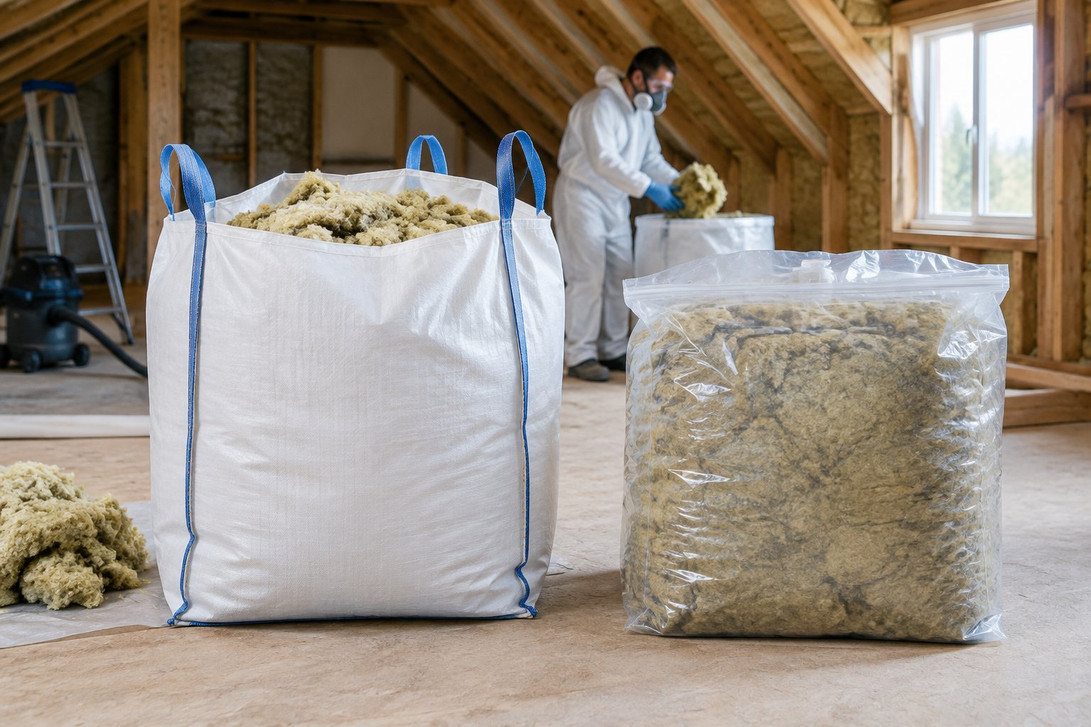
Most contractors who ask us at RAM about FIBC bulk bags for insulation removal have a stack of them already. They came in with a delivery of sand, pellets or seed, they're tough, they're big, and it seems a shame to throw them away when the next job needs somewhere to put a few hundred cubic feet of old fiberglass.
The short answer is that a bulk bag can hold insulation but makes a poor bag for an insulation vacuum. It was designed to be filled from above with a dry, heavy product and lifted with a forklift, not to act as the filter on the exhaust of a high-volume removal machine. Where a bulk bag can still help is with material you've already bagged or pulled by hand.
Bulk bags were designed for a forklift, not for exhaust air
FIBC stands for flexible intermediate bulk container. The typical one is a cube of woven polypropylene with a lift loop at each corner, a fill opening at the top (either a spout or an open duffle top) and sometimes a discharge spout underneath. Everything about it is tuned for one job: carrying a dense, flowable product such as grain, aggregate or plastic pellets, then being picked up by a forklift or hoist.
Those design priorities explain why it struggles on a removal job:
- Strength goes into weight, not filtration. A bulk bag's fabric is engineered to carry heavy loads safely. Insulation is light and bulky, so you run out of volume long before the bag's weight rating matters, and the strength you're paying for sits unused.
- The fabric isn't specified as a filter. Many bulk bags are coated or lined so fine powders can't sift out. A coated bag is close to airtight, which on a vacuum exhaust means it inflates and strains like a balloon. An uncoated bag lets air through the weave, but nobody has rated it for filtering insulation dust.
- The spout is for pouring. A fill spout is meant to be tied around a hopper chute. It isn't sized or reinforced to hold a vibrating vacuum hose, and an open duffle top gives you nothing to connect to at all.
What goes wrong when you hook one to a vacuum
Crews who try it usually hit the same three problems in the first hour.
The first is dust. Cellulose produces very fine dust, and an uncoated woven fabric lets plenty of it through. Even our own woven Flex-Bags, which are purpose-built for vacuums, are not low-dust bags and we steer people away from them for cellulose. A bulk bag designed for pellets is a step further from the job.
The second is the connection. With the hose stuffed into a spout and taped, it shifts as the machine runs, the spout works loose and dust escapes around the hose. Meanwhile nails and wood scraps hit the same patch of fabric inside the bag on every pass. Our bags are made around a hose: a 12 by 10 inch easy-fill spout sized for hoses as big as 10 inches. Even so, we tell every crew to feed them through a length of hose off the machine, because debris that has traveled a few feet hits the fabric far softer than debris straight off the fan.
The third is size in the wrong places. A bulk bag holds far more than a 75 cubic foot vacuum bag but much less than a trailer or dumpster liner, so it lands in an awkward middle. It's too big to carry down a ladder and too small to save you much changeover time on a large attic.
Where bulk bags still earn a spot on the truck
That doesn't make a stack of bulk bags useless. They're handy for:
- Hand-pulled batts. Fiberglass and rock wool batts stuffed into a bulk bag in the driveway don't involve exhaust air, so the filtration problem disappears.
- Demo debris. Old baffles, broken boards, ductwork scraps and other non-insulation waste are better in a tough bag than through a vacuum hose.
- Moving filled vacuum bags. If you have a loader on site, a few closed insulation bags dropped into a bulk bag can be lifted onto a truck in one move.
Second-hand bulk bags come with a caution: you don't always know what they carried before. A bag that once held fertilizer, chemicals or feed can leave residue in a client's driveway, and many bulk bags are only rated for a single trip anyway. Check the label and the fabric before you reuse one.
Purpose-built bags at every scale
The reason the bulk bag question comes up at all is usually volume. Contractors want something bigger than a 75 cubic foot bag. For that, the right answer is a large-format vacuum bag rather than a bag borrowed from another industry.
|
FIBC bulk bag |
Standard insulation vacuum bag |
Large-format trailer or dumpster bag
|
|
|---|---|---|---|
|
Built for |
Dry bulk products, forklift lifting |
Vacuum exhaust, carried by hand |
Vacuum exhaust, filled in place |
|
Fabric |
Woven, often coated |
Non-woven or woven, made to filter exhaust air |
Tough fabric with 5-thread poly seams |
|
Hose connection |
Pour spout or open top |
Easy-fill spout |
Built-in inlets |
|
Capacity |
Varies by bag |
75 to 115 cu ft |
320 to 840 cu ft |
|
Lift loops |
Yes |
No |
No, filled inside the trailer or roll-off |
Our 12 Yard bag holds 320 cubic feet, comes four to a case and sits in a standard dump trailer bed or a 15 to 40 yard dumpster with a single inlet. The bigger four-inlet models go up to 840 cubic feet and can take two machines at once. You can compare them all on our trailer and dumpster bag page.
At the standard size, choose by material. For dusty cellulose or anything wet, the PRO-450 Super Duty has our highest filtration and a 450 pound rating. If the bulk bag appeal was sheer size and the attic is fiberglass or rock wool, our woven Flex-Bag with EZ Fill collar gets you 115 cubic feet in a bag that still fills from a vacuum, with a spout big enough for a 12 inch hose. Its handles are for repositioning, not for lifting it full. If it's your first Flex-Bag order, call us first and we'll check it suits your machine.
No bag in that table is HEPA rated, ours included, and a recycled bulk bag certainly isn't. Treat vermiculite as asbestos-containing, have any other suspect insulation tested before it's touched, and hand asbestos jobs to a licensed abatement crew.
Swap the borrowed bags for ones built for the job
Run the job through our free bag calculator to see how many standard bags, or which large-format bag, the attic needs. For a big job where you're weighing large-format against standard bags, ring us on 404-354-6268. We're a small family business, someone picks up 24/7, and every order leaves the same day with free shipping.
Frequently Asked Questions
Is a coated or uncoated bulk bag better for insulation?
Neither suits a vacuum. A coated bag traps the exhaust air and balloons, while an uncoated one breathes but leaks fine dust. If you're going to use a bulk bag at all, keep it for hand-bagged batts or debris where no exhaust air is involved.
Can I lift a filled insulation vacuum bag with a forklift?
Insulation vacuum bags don't have lift loops and aren't designed for it. That's why our large-format bags are filled in place inside the trailer or dumpster, so the bag never has to be lifted when it's full.
Do bulk bags save money over insulation vacuum bags?
Only on paper. The cost turns up later as extra cleanup from dust blowback, lost time fixing a loose hose connection and bags that split under debris strikes. On a client's property, a cloud of cellulose dust in the driveway costs more in goodwill than any bag.
What's the biggest insulation vacuum bag RAM makes?
The 30 Yard dumpster bag. At 840 cubic feet it holds roughly what eleven standard bags would, it's sized to line a 30 yard roll-off, and its four inlets let two vacuums feed it together.
Can bulk bags go to the landfill with the insulation inside?
That depends on the facility. Some take bagged insulation in any sturdy bag, others have rules about packaging or want to see the material. Call ahead before you haul.