
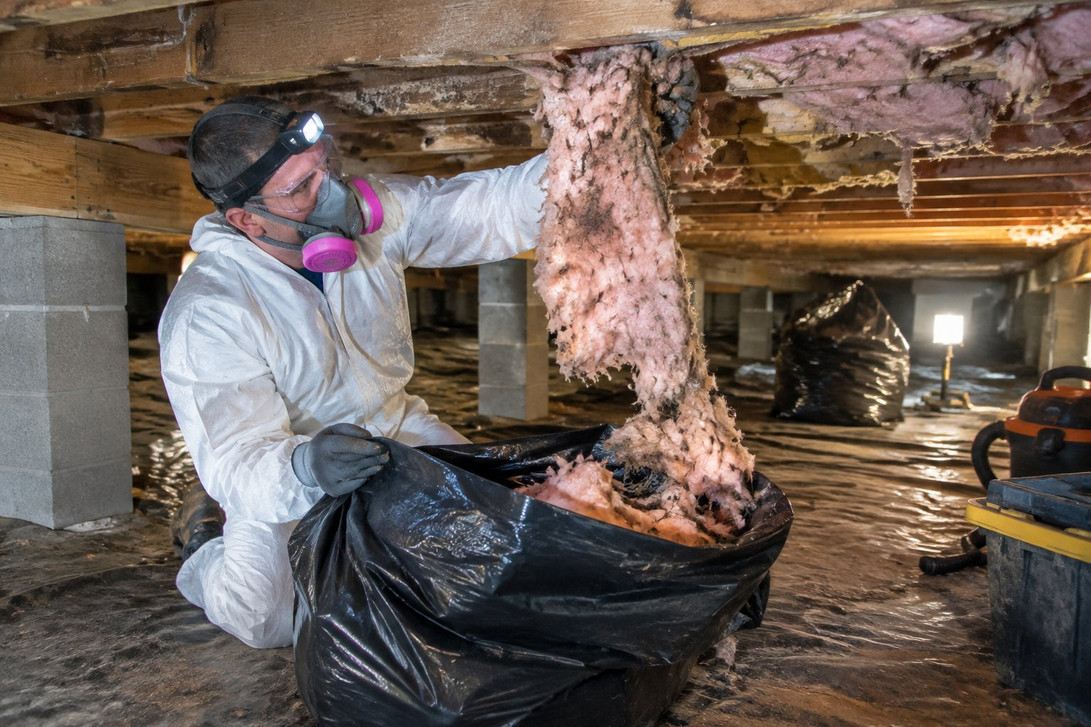
The call usually starts the same way: "Some of the insulation under the house has fallen down." By the time you get your head and a flashlight through the access door, you find that some means half, the batts lying on the ground are soaked, and a few have been turned into nests.
Crawl space insulation removal is mostly a hand job. Under-floor batts get pulled down and stuffed into bags, while the vacuum earns its keep on the shredded fiberglass, fines and loose debris left on the ground afterward. Everything bulky stays outside the access, and nothing new goes up until you know why the old insulation failed.
Fallen batts tell you what went wrong
Before anyone starts pulling, read what's already on the ground. The way crawl space insulation fails points straight at the problem the homeowner is paying you to solve.
- Batts hanging in a belly between support wires, dry and clean. Usually just tired supports or wires that were never spaced tight enough. If the fiberglass is in good shape, rehanging can be an option.
- Batts on the ground, heavy, gray and smelling musty. Water. Look for a plumbing leak overhead, condensation dripping off ductwork, or ground moisture coming up through a torn or missing vapor barrier.
- Paper facing chewed, tunnels through the batts, droppings on the barrier. Rodents. This is a contaminated-insulation job, with different PPE and a different bagging routine.
- Dark staining on the subfloor or joists above where batts were tight. Moisture trapped against the wood. Note it for the moisture meter once the insulation is down.
That read also settles the scope: a partial pull or a full tear-out. Clean, dry bays can stay. Anything wet, compressed, moldy or fouled by animals has to come out, because porous insulation can't be cleaned back to a usable state.
One more check before you commit: older homes sometimes have heating pipes in the crawl space wrapped in material that may contain asbestos. If you see old pipe wrap, or any pebble-like vermiculite, leave it alone and get it tested. No insulation vacuum bag, ours included, is HEPA rated or suitable for asbestos work, so that material belongs with a licensed abatement contractor.
Set up outside before anyone goes under
Crawl space jobs go wrong when the work area fills up with equipment. Keep it empty.
Park the vacuum outside on stable ground near the access door, or by a foundation vent you can pull and use as a hose port. Point the exhaust away from the opening, doors, windows and any air intakes, because a crawl space access is often right beside the outdoor HVAC unit or a dryer vent, and you don't want fiberglass dust drawn back into the house.
Then lay a tarp at the access as a staging area for empty and full bags. Every bag that gets filled underneath should come straight out to that tarp, not pile up beside the person working. Full bags inside a crawl space block the only exit, and in a 24 inch crawl space there's rarely a second one.
Measure the access opening while you're there. Plenty of crawl space doors are small, and that decides which bags you can actually get in and out of the hole.
Batts come down by hand, one bay at a time
Work in bays, starting at the point farthest from the access so you're never dragging bags over cleared ground. Pull the support wires or netting, let each batt down gently into your arms rather than letting it drop, then fold or roll it and push it into the bag. Rolling a batt in on itself traps most of the loose fiber and dirt inside. Dragging it across the soil does the opposite.
Bag choice under a house comes down to what you can move through the access:
|
Situation |
Bag that fits
|
|---|---|
|
Small access door, bags filled inside and dragged or passed out |
PRO-200 small bags, 5 ft x 22 in x 22 in, about 250 lb each, fit through a 22 in opening |
|
Bulky dry fiberglass batts going straight into a bag at the access |
13 ft Flex-Bag Multiuse, 115 cu ft, rated for batt removal or machine removal |
|
Wet, heavy batts or vacuumed fines with the machine outside |
PRO-450 Super Duty, 75 cu ft, 450 lb, our lowest-dust bag |
The Flex-Bag is a woven bag that breathes freely, which suits fiberglass and rock wool but makes it the wrong choice for fine, dusty material. If it's your first time ordering one, give us a call so we can check it's the right fit.
Wet batts are where crawl space jobs catch people out. Soaked fiberglass is far heavier than dry, so a bag hits its weight rating while it still looks half empty. Fill those bags well short of the usual 85 percent mark, keep them small enough to drag out without tearing, and use your strongest bag for them.
Vacuum what's left on the ground
Once the batts are out, the ground is usually covered in shredded fiberglass, crumbs of facing and whatever fell down with the insulation. This is where the vacuum pays for itself, especially if the existing vapor barrier is staying.
Keep the hose nozzle working just above the plastic rather than dragging it along, so you lift the debris without sucking up or tearing the barrier. Hose management is the other crawl space headache: the line has to snake around piers, ducts and drain lines, and every snag pulls the nozzle off the work. Hang it from joists with a couple of loose hooks where it changes direction and have a second person outside feeding slack and swapping bags.
Skip the vacuum for anything that's been fouled by rodents. The CDC's guidance on cleaning up after rodents says not to sweep or vacuum droppings, urine or nesting material, because it can put virus-carrying particles in the air, and that contaminated insulation should go into plastic bags. Treat and hand-bag those batts as their own step before the main pull. Microporous coveralls like our Microvek suits are the better pick for that kind of damp, dirty work.
The vapor barrier decides what happens next
Most crawl space insulation removal jobs end up involving the plastic on the ground, one way or another. If it's intact and staying, protect it: put down a crawl board or a piece of plywood where you kneel, keep tools off it and patch any punctures you make.
More often it's torn, buried or missing, and the homeowner's real project is a new ground cover or a full encapsulation. In that case the insulation comes out first, then the old plastic and debris, then the new barrier goes in. The Department of Energy's crawl space vapor retarder job aid calls for a ground cover of at least 6 mil, seams overlapped by at least 12 inches and the plastic run at least 6 inches up walls and piers, and that's easier to install over a clean floor than around leftover insulation.
Whether new insulation goes back between the floor joists or onto the foundation walls depends on whether the crawl space stays vented or gets sealed. Either way, the leak, the condensation or the bare soil that ruined the last batts has to be fixed first. Hang new fiberglass over the same moisture problem and you've booked yourself the same removal job in a few years.
Get the bags under the house before the first batt drops
For crawl space work, a mix usually covers it: small bags for anything that has to come through a tight access, a heavier bag for wet material and a long woven bag for the dry batts. You'll find the full RAM range on our insulation vacuum bags page. Every order ships free the same day within the US, and if you want help matching bags to the access hole and the mess under the floor, call us at 404-354-6268. We answer 24/7.
Frequently Asked Questions
Can I rehang crawl space insulation that fell down?
Only if it's dry, clean and still fluffy. Batts that have been wet, compressed, chewed or sitting on damp soil won't perform properly when they go back up, and they may hold mold. Rehanging also means fixing whatever brought them down in the first place, whether that's spaced-out support wires or a moisture problem.
Should I use a vacuum or pull crawl space insulation by hand?
Both, in that order. Faced and unfaced batts come out fastest by hand, rolled straight into a bag. The vacuum is for the loose fiberglass, shredded pieces and light debris left behind, and for loose-fill insulation if someone blew it in under the floor.
How long does it take to remove insulation from a crawl space?
It depends far more on clearance than on square footage. A crawl space you can move around in on hands and knees goes quickly, while a low, cramped one with ducts and plumbing in the way can take several times as long for the same floor area. Wet material, rodent contamination and a small access door all add time.
Do I need to remove the old vapor barrier too?
Not always. A barrier that's intact, properly lapped and still covering the ground can stay if the new plan doesn't call for something heavier. If it's torn, buried under debris or fouled by animals, it usually comes out after the insulation so the replacement can go down on clean ground.
How many bags will a crawl space need?
Measure the floor area being cleared and the batt thickness, then run the numbers through our free bag calculator, which also lets you account for wet or packed material. Add 10 to 15 percent on top for crawl space work, because wet batts fill bags by weight long before they fill them by volume.