
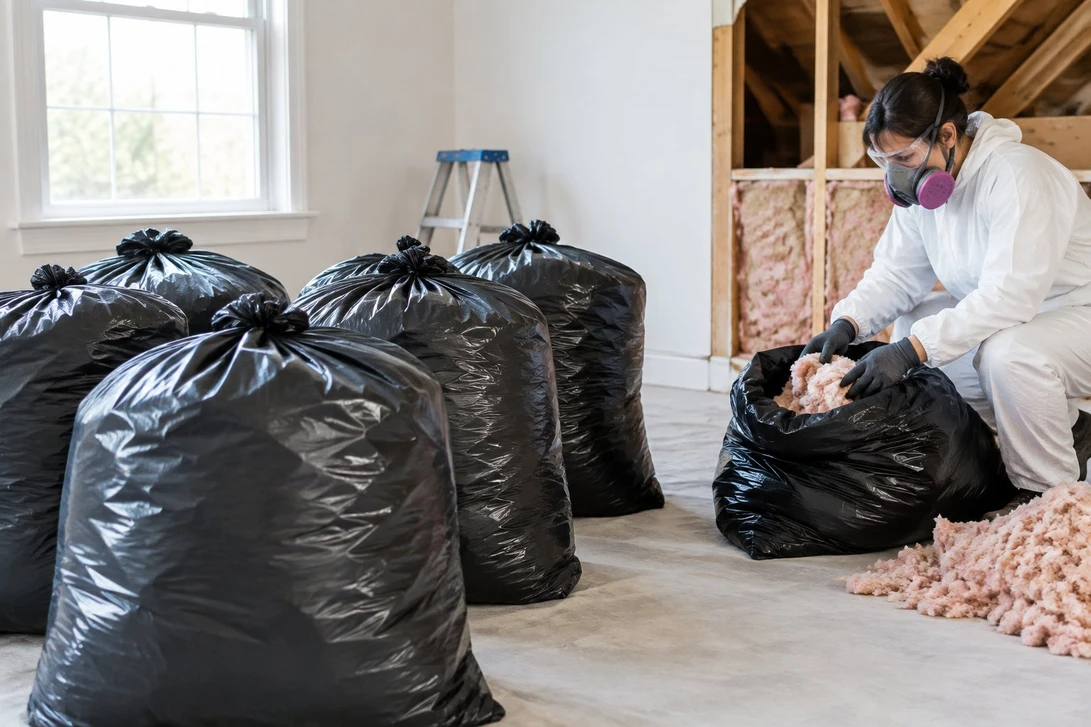
Every few weeks someone calls us at RAM with the same plan: rent an insulation vacuum, buy a couple of boxes of contractor trash bags and save a bit on the job. It sounds sensible until the first bag is taped onto the exhaust, the machine fires up and the plastic swells like a weather balloon.
Contractor trash bags for insulation removal are a good tool in one situation and a bad one in another. Use them for anything you pull and stuff by hand, like fiberglass batts, a small patch of loose fill or the scraps around a hatch. Never use them on a vacuum. A removal vacuum needs a bag that lets air out through its walls, and plastic doesn't.
A vacuum pushes air, and plastic gives it nowhere to go
An insulation removal vacuum works by moving a huge volume of air. That air carries the insulation down the hose and out the exhaust, and every cubic foot of it has to escape somewhere at the other end. A proper insulation vacuum bag is a filter: air passes out through the fabric while the fibers stay inside.
A plastic trash bag is airtight. Clamp one onto the exhaust and the pressure has nowhere to vent, so the bag inflates in seconds and splits at the seam or blows off the hose. Crews who try to get round this by cutting holes or leaving the neck loose end up with the worst of both worlds: a jet of dust and fiber blowing out of the opening, straight back across the driveway.
There are three more problems even if you could solve the airflow:
- Debris. A vacuum throws nails, staples and splinters out of the exhaust. Thin plastic punctures on the first roofing nail.
- The connection. Trash bags have no spout, so there is nothing to seat the hose into. You end up with duct tape wrapped around a vibrating hose, which holds for about as long as you'd expect.
- Volume. A 42-gallon contractor bag holds under 6 cubic feet. One of our 75 cubic foot vacuum bags holds as much as a dozen or more of them, and you'd be stopping the machine every couple of minutes to swap.
Hand-bagged batts are the trash bag's home ground
None of that matters when there's no vacuum involved. Fiberglass and rock wool batts come out by hand, one at a time, folded in half and stuffed into whatever bag is open. A heavy-duty contractor bag is a perfectly reasonable way to do that on a small job, and most DIYers already have a box in the garage.
Trash bags also make sense for:
- A small patch of loose fill around a leak or a repaired ceiling, scooped out with a dustpan or a rake.
- Odds and ends that shouldn't go through a vacuum anyway, such as old wood, cardboard baffles and the odd piece of ductwork tape.
- Double-bagging material that has to be kept sealed for disposal, once it's out of the attic.
A few habits keep hand bagging tidy. Fill the bag inside the attic rather than carrying loose insulation across the floor. Gather the neck slowly so the bag isn't tied off ballooned with trapped air (a balloon of a bag pops when someone sets a second one on top), but don't press it flat either, because that air carries the dust straight out past your hands. Keep the weight reasonable, since thin plastic dragged over joists and nail tips tears easily, and protect the carry route through the house.
On larger batt jobs the trash bag count adds up quickly. Our 13 ft Flex-Bag Multiuse is built for that situation: it's a 115 cubic foot woven bag you can stuff batts into by hand, or hook to a vacuum on the same job if the attic turns out to have loose fill underneath. If it's your first order of that bag, give us a call first so we can make sure it suits your setup.
Loose fill needs a vacuum, and a vacuum needs a filter bag
Scooping blown fiberglass or cellulose into trash bags is possible, but it's slow, filthy work. Every scoop throws dust into the air you're breathing, and an attic with 10 or 12 inches of loose fill can swallow a whole box of bags before you're halfway to the hatch.
This is where a vacuum and a proper bag earn their keep. The material goes down an enclosed hose to a bag that sits outside the house, and you never handle it directly. What to look for in that bag:
|
Need |
Trash bag |
Insulation vacuum bag
|
|---|---|---|
|
Lets exhaust air escape |
No |
Yes, through the fabric |
|
Fill spout for the hose |
No |
Yes, fits hoses up to 10 inches |
|
Survives debris from the exhaust |
Rarely |
Yes, especially with a hose section between machine and bag |
|
Capacity |
Under 6 cu ft |
75 to 115 cu ft for standard bags |
|
Good for hand-bagged batts |
Yes |
Some models (Flex-Bag Multiuse) |
For a DIY attic, the main choice is between our standard bags. The non-woven PRO-350 handles dry fiberglass and cellulose. Step up to the PRO-400 if there's rock wool in the mix, and to the PRO-450 if the material is damp, heavy or very dusty. If your attic hatch is tight or you can't get the hose all the way to the work area, our PRO-200 small bags fit through openings of 22 inches or more and hold about 250 pounds each, so you can fill them up in the attic and carry them down.
Two setup rules apply whichever bag you choose. The machine lives outside the house, and the bag never goes directly on the machine's outlet. Give it a few feet of hose first, so the nails and splinters lose their speed before they meet the fabric.
Mixed attics usually need both
Plenty of older homes have batts laid over loose fill, or a layer of blown cellulose added on top of the original batts years later. On a job like that, work in two passes. Pull the batts first and bag them by hand, then vacuum the loose fill underneath into proper vacuum bags. Trying to vacuum batts chokes the hose, and trying to hand-bag a foot of loose fill wears out the crew.
Before either pass, take a close look at what's in the attic. Gray-brown, pebbly loose fill that looks like mica may be vermiculite, which can contain asbestos. Neither type of bag is the right container for asbestos: our vacuum bags aren't HEPA rated (no one's are), and a trash bag is worse. The EPA's advice is to assume vermiculite contains asbestos and leave it undisturbed, so stop there and call a licensed abatement contractor.
Order the right bags for the attic you've got
Work out the loose-fill portion with our free bag calculator, keep a box of contractor bags for the batts, and grab a pack of disposable coveralls so the fiberglass stays off your clothes. The full lineup of vacuum bags for loose fill ships free the same day. If you can't decide which one your attic needs, ring us on 404-354-6268 at any hour and a real person will talk it through.
Frequently Asked Questions
Can I put a trash bag over the vacuum exhaust as a pre-filter?
No. Anything airtight on the exhaust side builds pressure until it bursts or chokes the machine. The bag on the exhaust has to be the filter, so use a purpose-made insulation vacuum bag and let it do that job.
How many contractor bags does it take to clear an average attic?
For loose fill, far more than most people expect. A 1,000 square foot attic with a foot of blown insulation holds roughly 1,000 cubic feet of material, which works out to somewhere near 180 contractor bags before you allow for any spillage.
Are trash bags fine for rodent-contaminated insulation?
Only as an outer layer when you seal bags for disposal. The CDC warns that stirring up rodent droppings and nesting material can put hantavirus into the air, so hand-scooping a soiled attic into thin plastic is the wrong approach. Heavily contaminated insulation is a job for a crew with proper respiratory protection, and for the bag itself we point people to the PRO-450 Super Duty, which has the highest filtration we make.
Will my landfill take insulation in black trash bags?
Many facilities accept bagged insulation, but rules vary by location, and some want clear bags or a specific type of container. Call your transfer station or landfill before you haul anything.
Would a thicker plastic bag hold up on the vacuum?
No. A 3 mil or 6 mil bag resists nail punctures a little better, but the real problem is that plastic doesn't breathe, and thickness does nothing about that. A thicker bag just takes a second or two longer to balloon before it lets go.