
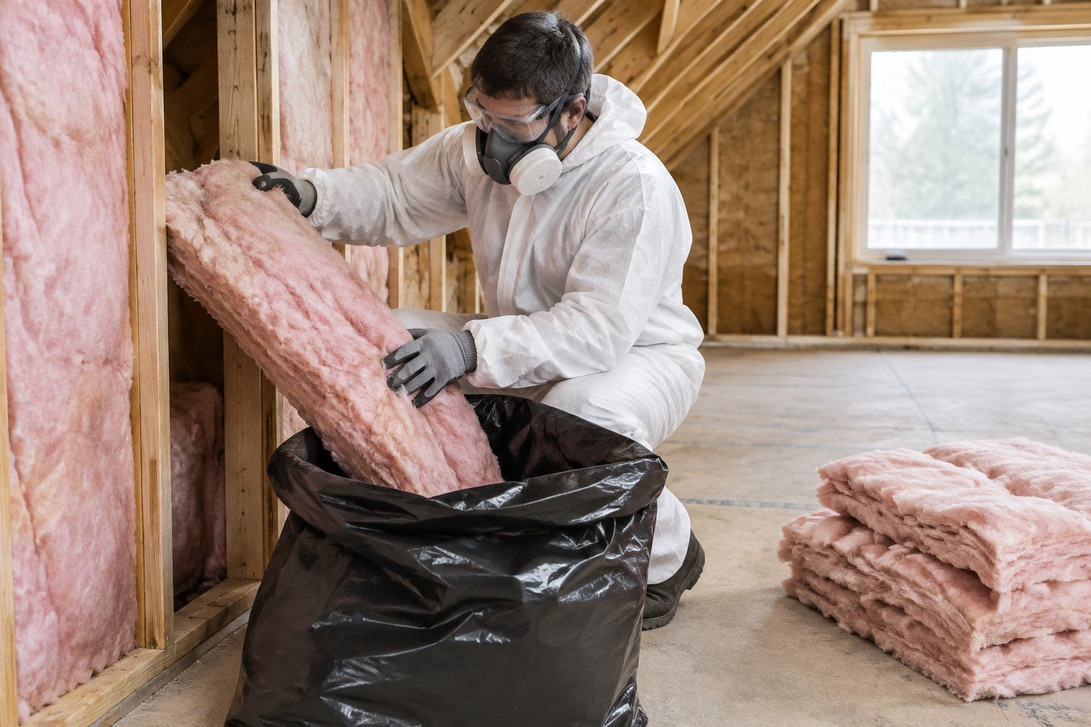
Batts are the one kind of insulation you can't really vacuum. Feed a whole fiberglass batt into a removal hose and it bunches, wraps around itself and stops the line dead. So batt insulation removal is a hands job: you lift the batts out, roll them, and stuff them into a bag right where you're standing.
That sounds slow, and done badly it is. Done well, with the right bag open next to you and a sensible order of work, a crew can clear an attic of batts surprisingly fast. The difference is almost entirely in the bagging.
The order of work on a batt job
Get the empty bags up first. Batt jobs stall when someone has to climb down for a fresh bag with an armful of fiberglass. Take a few up before the first batt moves and lay them out along your route.
Free the batts before you pull them. Unfaced batts usually just lift out. Faced batts (kraft paper or foil on one side) are often stapled to the sides or faces of the joists or studs. Pop the staples with a flat bar or pliers, or slice along the flange with a utility knife, rather than ripping the batt free. A torn batt sheds far more fiber than an intact one.
Roll, don't wad. Lift each batt by its edges and roll or fold it toward the middle so the dusty surface ends up inside. A rolled batt goes into a bag cleanly. A batt that's been balled up loses its shape, takes more room and throws fibers every time you touch it.
Bag it at arm's length. Every trip across the attic carrying a loose batt is a trail of fiberglass. Keep the bag next to you and move it as you go.
Mixed attics: dig the batts out from under the loose fill. A common layout is old batts on the bottom with loose fill blown over the top. Vacuum the loose layer off first until the batts are exposed, then pull and bag them by hand. Trying to drag a batt out from under six inches of blown fiberglass just spreads the fill around.
For more on handling fiberglass itself, including what it does to skin and how crews deal with the itch, see our guide to removing fiberglass insulation.
Why the bag decides how fast you go
The usual way to bag batts is with whatever bags are on the truck: contractor trash bags that hold a batt or two, split on a nail and need a trip down the ladder every few minutes. The bottleneck isn't pulling the batts, it's how often you stop to deal with a full or torn bag.
Batts are long, typically four to eight feet, and a bag built for a vacuum hose has a small spout that you'd have to fold every batt down to fit through. What speeds things up is a long bag with a wide mouth, so a rolled batt slides in without fuss, and enough volume that you're not swapping bags every few minutes.
Our two Flex-Bags for batt work
|
Flex-Bag with EZ Fill collar |
13 ft Flex-Bag Multiuse
|
|
|---|---|---|
|
Size |
14 x 3.6 ft |
13 x 3.6 ft |
|
Capacity |
115 cu ft, 400 lb |
115 cu ft, 400 lb |
|
Fabric |
Woven polypropylene |
Woven polypropylene |
|
Opening |
18 x 12 in EZ Fill collar, hoses up to 12 in |
Set up for machine removal or hand-loaded batts |
|
Extras |
Handles to help move the bag |
Built to switch between vacuum and batt work |
|
Material |
Fiberglass and rock wool |
Fiberglass and rock wool |
The Flex-Bag with EZ Fill collar and handles is the one most crews reach for on batt jobs. The collar holds the mouth open while you feed rolled batts in, and at 14 feet long it takes them without much folding. The handles help you drag and position the bag across the work area, but they aren't rated for the full weight of a loaded bag, so don't try to lift a full one by them.
The 13 ft Flex-Bag Multiuse is built for crews who want one bag on the truck for both kinds of work: hand-loaded batts in one attic, a vacuum hose in the next. If you're new to either Flex-Bag, give us a call before your first order and we'll walk you through setting it up.
Both are woven bags, which means they breathe well but they aren't low-dust bags. That's fine for fiberglass and rock wool, which is what they're made for. If the batts are coming out of an attic that also has blown cellulose, use a non-woven bag for the cellulose part of the job.
Bagging technique that keeps fibers in the bag
- Lay the bag out flat and open the collar fully before the first batt goes in, so you aren't fighting the fabric with your hands full.
- Feed batts in lengthwise, pushing each one down to the far end so the bag fills from the bottom up.
- Compress gently. A little pressure lets you fit more batts in, but crushing them pushes dust back out of the mouth.
- Leave the top of the bag empty. With batts it's tempting to cram in one more, but you need spare fabric to gather and close the bag, and an overstuffed mouth sheds fiber every time it's moved.
- Close each bag before you move it, and keep it off nails, shingles and sharp roof edges on the way to the truck.
A 14 foot bag won't go down every attic ladder, though. For a narrow hatch, keep a pack of our PRO-200 small bags on the truck: they're 5 feet long, 22 inches square and pass through a 22 inch opening, so a few rolled batts fill one and it comes down at a weight one person can handle.
What changes in walls and crawl spaces
Walls. Batts in exterior walls come out once the drywall is open, and they're friction fit or stapled to the studs. The same roll-and-bag routine applies, standing up instead of crouching. Watch for electrical boxes the batts were cut around.
Crawl spaces. Under-floor batts are pulled overhead from your back, held up by wire supports or netting. The same roll-and-bag routine works, but wet batts are common down there and much heavier, so fill those bags by weight rather than by eye.
Attics. Step only on joists or boards laid across them, and know where the wiring, junction boxes and recessed lights are before you start pulling. Batts that were laid over knob and tube wiring or have animal droppings in them are a reason to stop and reassess before carrying on.
When to stop pulling
If you lift a batt and find vermiculite underneath (small gray-brown or gold pebbles), stop. It may contain asbestos, and no insulation vacuum bag, RAM included, is HEPA rated or suitable for it; get it tested and use a licensed abatement contractor. Heavy rodent contamination, extensive mold or droppings are also reasons to pause and set up proper protection before you disturb the material.
Coveralls matter more on batt jobs than vacuum jobs, because your arms are full of fiberglass for hours. Breathable Cool-Suits keep fibers off your skin without cooking you in a summer attic. Add a properly fitted respirator, eye protection and gloves.
Put the right bags on the truck
If your crew is still bagging batts into trash bags, a Flex-Bag with the EZ Fill collar is the single biggest time saver we can offer you, and the 13 ft Multiuse makes sense if your jobs swing between batts and loose fill. Call 404-354-6268 (answered 24/7) to talk through your first order, and it ships free the same day.
Frequently Asked Questions
Can old fiberglass batts be reused?
Clean, dry, undamaged batts can technically be reused, but most batts that come out on a removal job are compressed, dusty, wet or contaminated, which is why they're coming out. Batts with droppings, mold or water damage should always be disposed of.
Is it faster to cut batts into pieces before bagging?
Usually not. Cutting creates more loose fiber and more pieces to handle. With a long bag like the Flex-Bag, a rolled batt goes in whole, which is faster and cleaner.
How many batts fit in a Flex-Bag?
It depends on the batt thickness and how much you compress them. A Flex-Bag holds 115 cubic feet, so a batt job uses far fewer bags than one with trash bags, but thick attic batts fill it sooner than thin wall batts.
Do kraft-faced batts need different handling?
Mainly at the staples. The paper facing tears easily and holds dust, so free the flanges cleanly and leave the facing attached. Roll the batt with the paper on the outside: it holds the roll together and keeps the loose fiber face tucked inside.
Can I vacuum up the scraps once the batts are out?
Yes. Once the batts are bagged, a removal vacuum is the fastest way to clear the crumbs, dust and loose bits left between the joists. Small scraps go through the hose without trouble; it's whole batts that cause clogs.