
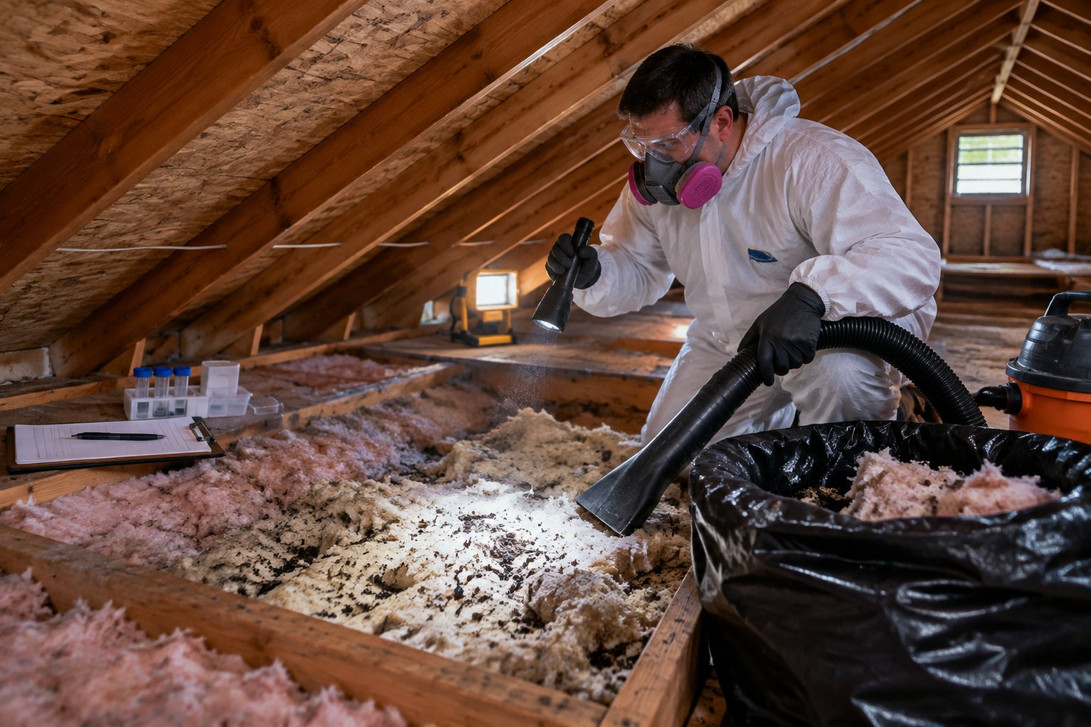
Bats are the one attic pest you can't always evict on your own schedule. Many bat species are protected, mothers raise flightless pups in summer roosts, and sealing the house at the wrong time can trap a colony inside. So when you find bat droppings in the attic, the order of work matters as much as the cleanup itself.
The sequence is: confirm it's bats, get them out with a lawful one-way exclusion at the right time of year, then remove the guano wet, with respirators, and take out the insulation it has piled onto. Bat guano's main health risk is histoplasmosis, a fungal infection people catch by breathing in dust from disturbed droppings, so the whole job is built around keeping that dust down.
Guano crumbles, and that's how you tell it from mouse droppings
Bat and mouse droppings are similar in size and color, and they get confused all the time. The quickest field test: press one with a stick or a gloved fingertip. Bat guano crumbles into dry powder, often glittering with the shiny wing and leg fragments of the insects the bats ate. Mouse droppings stay firm and smear rather than crumble.
The pattern helps too:
- Piles, not trails. Bats drop guano where they hang, so it collects in mounds directly under the roost: along the ridge, at gable ends, around the chimney chase.
- Staining at the exit. Dark rub marks and streaks around a gap at the soffit, ridge vent or gable louver where bats squeeze in and out.
- Droppings on outside walls and windowsills below the exit point.
- Squeaking and rustling at dusk, when the colony heads out to feed.
Watch the suspected exit at sunset from outside. Bats leaving one by one is the clearest confirmation you'll get.
Histoplasmosis comes from the dust, not the pile
Histoplasma is a fungus found in the environment, and soil or material containing bird or bat droppings raises the risk. The trouble starts when someone sweeps it, shovels it dry, walks through it or blows it around, and the spores become airborne.
The CDC's histoplasmosis prevention page says large amounts of bird or bat droppings should be cleaned up by professional companies that handle hazardous waste. It also lists the groups at higher risk, including people with HIV/AIDS, organ transplant recipients, people on certain immune-suppressing medications, adults over 55 and infants. Anyone in those groups should stay well away from the attic and the route the waste takes out of the house.
There's no disinfectant shortcut either. NIOSH's guidance on controlling Histoplasma exposure notes there are no EPA-registered products specifically approved as effective against Histoplasma. Control comes from keeping the material wet and removing it, not from spraying it and leaving it.
Exclusion first, and only at the right time of year
Cleaning out guano while bats still roost overhead means doing it twice. The bats have to go first, and how and when they go is the part most likely to land a contractor in trouble.
- Maternity season. In summer, many colonies have pups that can't fly yet. Exclude the adults then and the young are left to die in the attic. There's no single national window for this; it varies by species and by state.
- Protection. Several bat species are protected, and rules on excluding them differ from state to state. Get your state wildlife agency's answer before any exclusion device goes up or any opening is sealed.
- Method. The accepted approach is one-way exclusion: devices at the active exits that let bats leave but not return, followed by sealing every other gap. NIOSH's guidance is to identify and seal entry and exit points, even the smallest holes, and it notes that ultrasonic devices and chemical repellents are not effective for removing bats from a roost.
Never handle a bat with bare hands. If one gets into the living space or anyone may have touched one, contact your local health department or animal control for advice.
Dress for dust that falls from above
Bat attics have a quirk other wildlife jobs don't: the contamination is overhead as well as underfoot, because guano and dust coat the rafters and fall as you work. NIOSH's personal protective equipment guidance reflects that:
- Particulate-filtering, NIOSH-approved respirators, from filtering facepieces for medium-risk work up to full-facepiece respirators with 100-series filters or powered air-purifying respirators for high-risk work.
- Disposable coveralls with hoods where contaminated material is likely to fall from overhead.
- Disposable gloves worn under regular work gloves.
- Disposable shoe coverings with ridged, slip-resistant soles.
Our Microvek coveralls are microporous suits made as a barrier against hazardous dusts, with a storm-flapped two-way zipper, and with 50 in a pack, each technician can change into a fresh suit at every break without anyone rationing them.
Getting the guano and insulation out
NIOSH recommends against shoveling or sweeping dry, dusty material and suggests carefully spraying it to reduce what becomes airborne, noting that adding a surfactant to the water may help further. Wet the piles down before they're disturbed and keep them damp as you go; you want damp material, not water running into the ceiling below. Wetted material goes into secure containers for disposal under state and local requirements.
The insulation under a roost almost always comes out. Guano piles sink into loose fill, urine soaks through, and the material can't be cleaned in place. Wet guano-laden insulation is also heavy, so it needs a bag built for weight. Our PRO-450 Super Duty bag holds 75 cubic feet, is rated for 450 pounds and has our highest filtration and lowest dust.
For big colonies, NIOSH points to truck- or trailer-mounted vacuum systems for large accumulations, which keeps the collected material outside the building. Our trailer and dumpster bags sit in the trailer bed or roll-off container and take the whole load as it comes off the hose. Keep in mind that removal bags, ours and everyone else's, carry no HEPA rating: the bag contains the bulk material, while wetting, respirators and containment do the work of protecting people.
Have the gear staged before exclusion ends
Bat jobs often run on a calendar set by the colony, so it pays to have bags and suits on hand the day the attic is confirmed empty. Size the order with our free bag calculator as soon as you know the attic's footprint and guano depth. We ship RAM orders at no charge on the day they're placed, and if a colony job throws up something unusual, ring 404-354-6268; somebody picks up at any hour.
Frequently Asked Questions
Does bat guano carry hantavirus?
Hantavirus is a rodent problem. The CDC links it to rodents such as the deer mouse, not to bats. The concern with bat guano is histoplasmosis from disturbed dust, along with rabies risk if anyone handles a live bat.
Can the family stay in the house during guano removal?
Usually, yes, if the attic is contained, the HVAC system is off while work is under way and occupants keep clear of the hatch and the route the waste takes outside. Anyone in a higher-risk group for histoplasmosis is better off away from the house on removal days.
Will the bats come back next year?
They will try. Bats return to established roosts, so any gap left open after exclusion is an invitation. Sealing every opening, however small, before the next season is what keeps the cleaned attic clean.
Is it legal to kill bats in an attic?
In many places, no, and killing them also doesn't solve the problem, because dead bats in the attic create an odor and contamination problem of their own. Your state wildlife agency can tell you which species are protected locally and when exclusion is allowed.
Should the attic be reinsulated right after cleanup?
Only after the guano and contaminated insulation are out, the surfaces have dried and you've confirmed no bats are getting back in. Reinsulating over a missed exit point just gives returning bats a fresh roost.