
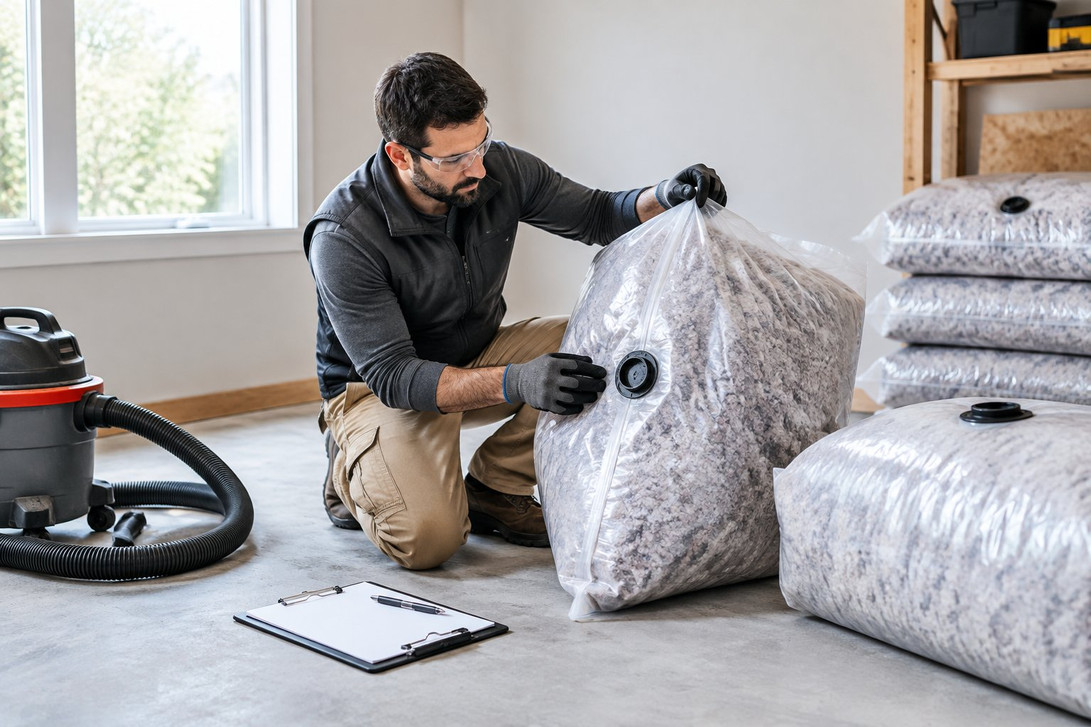
Here's a cost-saving idea we hear about more often than you'd think: fill the bags, drive them to the landfill, dump the insulation out, and bring the bags back for the next job. It sounds thrifty. In practice it costs more than it saves.
So, are insulation vacuum bags reusable? Not once they've been filled. A removal bag is the packaging the insulation goes to disposal in, and it's designed to stay closed from the attic to the landfill. Unused bags keep perfectly well between jobs, and almost everything else on the job (vacuum, hose, tarps, dolly) gets reused for years. The filled bag is the one item that should leave with the waste.
A removal bag is packaging, not a container
A tool bag or a storage bin is designed to be opened and closed thousands of times. An insulation vacuum bag is closer to a shipping box. Its job is to take loose fiber out of an attic, hold it while it's moved, and keep it contained all the way to the landfill. When the bag is tied off, the job of containing that material is done, and opening it again undoes the work.
Disposal rules for insulation vary by area, so check what your local landfill or hauler accepts, but plan on the bag going with the load.
Emptying a full bag puts the dust back in the air
Think about what dumping a bag actually involves. Someone unties the spout, tips a bag weighing a couple of hundred pounds or more, and shakes it until the last of the fiber falls out. Every bit of fine dust that settled inside during the fill goes straight into the air around that person. You've essentially repeated the dustiest part of the removal job, without the vacuum, outdoors, and often somewhere the wind can carry it.
On a contaminated job it's worse. Insulation that came out of an attic with rodent droppings, mold or smoke damage was bagged precisely so nobody would have to handle it loose again. Reopening those bags exposes whoever does the emptying and spreads the contamination onto the bag, the truck and the next job site. Don't do it.
A used bag isn't the bag you bought
Even if you could empty a bag cleanly, it wouldn't perform like new. During the fill, fine dust builds up in a filter fabric, and that loading doesn't shake back out. A bag that has done one job starts the second job partly clogged. Its seams and spout have also carried a full load and been dragged, lifted and tied, and wear on polypropylene isn't always visible. A clogged bag balloons sooner and a tired seam lets go sooner, so a reused bag tends to fail mid-fill, in the driveway, with the client watching.
Then there's time. Driving bags back, emptying them and inspecting each one is labor, and on most crews labor is the most expensive line on the job. A fresh bag is a small cost next to an hour of someone's day spent emptying old ones.
What you can reuse on a removal job
Plenty of the setup is built to last. These get used job after job:
- The vacuum. Our RAMVAC insulation removal vacuums are built with AR-500 steel fans in AR-400 steel chambers for exactly that reason.
- Hoses and connections, once they're cleaned out and checked for splits.
- Tarps for staging bags, as long as they're shaken out away from the house.
- Dollies, ladders and staging gear.
- Unused bags. A bag that was set out for the job but never connected is as good as new. Fold it back into the case and keep it for the next one.
Disposable coveralls go in the same category as filled bags. They're made to be worn once and thrown away, which is the point on a dirty attic job.
Cutting bag waste without reusing bags
If the real goal is fewer bags per job, there are better ways than reuse:
Order the right count. Overordering isn't waste if the extras ride along to the next job, but underordering leads to overfilled bags, which tear. Our free bag calculator gives a count for each bag model from the attic size, depth, material and condition.
Use a bigger bag where the material allows. On dry fiberglass, an 88 or 115 cubic foot bag means fewer bags than a 75. On heavy or wet material, the weight rating is what limits you, so a stronger bag filled sensibly beats a bigger one.
Line the trailer instead. On large jobs, trailer and dumpster bags hold 320 to 840 cubic feet each. One 20 yard trailer bag replaces about seven standard bags by volume, and it's still a single bag going to disposal.
Store spare bags properly. Keep unused cases dry and out of direct sun so they're in good shape when you need them.
Keep fresh bags on the shelf
The simplest way to never be tempted to reuse a bag is to never run short. Keep a case or two of your usual insulation vacuum bags on hand, and restocking is easy because shipping is free and leaves the same day. Crews who order regularly can ask about contractor pricing on 404-354-6268, a line we pick up 24/7.
Frequently Asked Questions
Can I reuse a bag that tore before it was full?
No. Whatever made it tear (a nail strike, a clogged fabric, too much weight) has left that spot weaker than the rest of the bag, and it will split again the moment the pressure builds. Tie off the contents, sleeve the damaged bag inside a second one for the trip to disposal, and carry on with a new bag.
Are insulation vacuum bags recyclable?
Our bags are polypropylene, but a used bag is full of insulation dust and debris, so don't assume a local recycler will take it. Treat a filled bag as part of the waste load unless your local facility tells you otherwise.
How long do unused bags keep in storage?
Kept dry, flat in their case and out of direct sunlight, unused bags stay in good condition between jobs. Sunlight is the main thing to avoid, since UV breaks down polypropylene over time.
Can I reuse a trailer or dumpster bag?
No. A trailer bag holds a full trailer load and is designed to be closed up and hauled off with the insulation inside. The empty trailer bed is what gets reused, ready for the next bag.
Should I reuse bags on a DIY project to save money?
We'd still advise against it. A homeowner emptying bags in the driveway gets the worst of the dust with none of the containment, and a few extra bags cost far less than a ruined weekend or a cleanup bill.